
How to Coordinate Subcontractors So Trades Show Up When You Need Them
Summary
Trades show up when they know exactly when they’re needed, what has to be ready for them and who to call when it changes. A confirmed two-week look-ahead, prompt change notifications and one shared schedule do more for attendance than any amount of chasing.
On this page
- Why don’t subcontractors show up on time?
- What is a two-week look-ahead schedule?
- Sample two-week look-ahead format
- How to coordinate subcontractors, step by step
- What to do when a sub doesn’t show up
- How to avoid stacking trades
- How to become the builder trades want to work for
- How Ally keeps trades coordinated
- Frequently asked questions
To coordinate subcontractors on a residential job, give every trade a confirmed start date from a shared two-week look-ahead, make sure the work ahead of them is actually ready, and notify them the moment something changes. Most no-shows trace back to unclear dates, work that wasn’t ready, or a change nobody passed along. Fix those three and attendance improves.
- Publish a two-week look-ahead every week and get an explicit confirmation from each trade.
- Confirm readiness before the trade arrives: predecessor work, materials, access and inspections.
- When a date moves, notify every affected trade the same day, from the same source.
- Track who owns each handoff so problems surface before a crew is standing around.
Why don’t subcontractors show up on time?
It’s tempting to blame unreliable subs, and sometimes that’s fair. More often, the cause is on the coordination side:
- Vague dates. “Sometime the week of the 12th” isn’t a commitment. Trades book the jobs that give them firm dates.
- The site wasn’t ready. A plumber who showed up last time to find framing unfinished will deprioritize you next time.
- Stacked trades. Two or three trades scheduled into the same space at once leads to someone leaving.
- Last-minute changes that never reached them. A date moved in the office, but the sub was still working from last week’s text.
- No single source of truth. Schedules live in a spreadsheet, a whiteboard and a dozen text threads.
Subcontractors juggle many builders. The ones who are easiest to work with — clear dates, ready sites, fast answers — get priority.
What is a two-week look-ahead schedule?
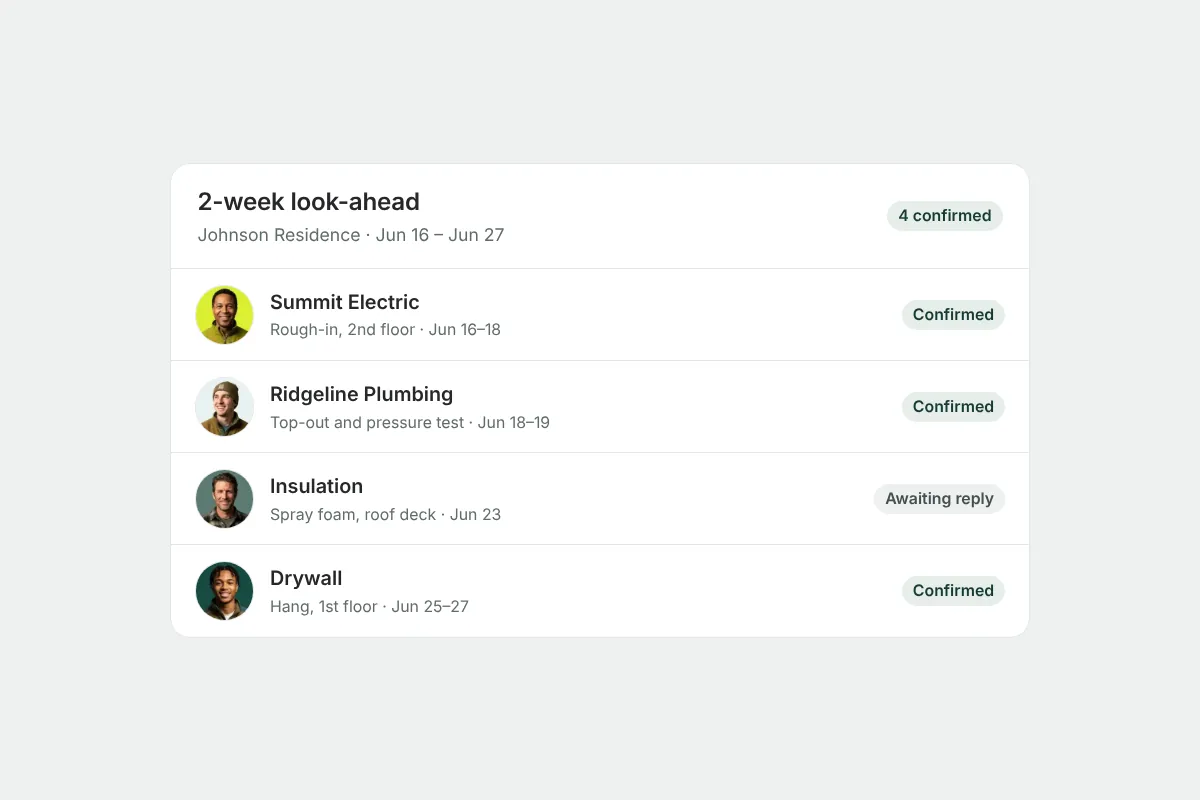
A two-week look-ahead is a short-range schedule pulled from the master schedule. It lists what each trade is doing over the next 10 working days, what must be complete or delivered before they start, and any decisions or inspections that gate the work. It’s updated weekly and shared with every trade on the job.
The master schedule answers “what happens when over the life of the project”. The look-ahead answers “who needs to be here, ready to work, in the next two weeks”. (For building the master schedule, see how to build a residential construction schedule.)
Sample two-week look-ahead format
Here’s an example for a custom home moving from rough-ins to insulation. Dates and trades are illustrative.
| Dates | Trade | Work | Must be ready first | Confirmed? |
|---|---|---|---|---|
| Mon–Wed, week 1 | Plumbing | Rough plumbing, second floor | Framing punch complete; valves on site | Yes |
| Tue–Thu, week 1 | Electrical | Rough electrical, first floor | Lighting plan approved by owner | Yes |
| Thu, week 1 | HVAC | Duct rough, attic | Plumbing vents in; attic access clear | Pending |
| Fri, week 1 | Low voltage | Pre-wire | Device locations walked with owner | Yes |
| Mon, week 2 | Inspector | Rough inspections (all trades) | All rough work complete and called in | Requested |
| Wed–Fri, week 2 | Insulation | Wall and ceiling insulation | Rough inspections passed | Tentative |
The “must be ready first” column is the one that prevents most wasted trips. If you can’t confirm it, don’t confirm the trade.
How to coordinate subcontractors, step by step
1. Keep one master schedule
Everyone works from the same schedule, with each line assigned to a trade or vendor. If trades are working from texts and the office from a spreadsheet, you have two schedules and neither is right.
2. Publish the look-ahead weekly
Pick a day — many builders use Thursday or Friday — and send the next two weeks to every trade on the job. Consistency matters more than the format.
3. Ask for explicit confirmation
A message that was sent isn’t a commitment. Ask each trade to confirm their dates and record the confirmation. Follow up on anything unconfirmed two or three working days before the start date.
4. Confirm readiness before the trade arrives
The day before a trade starts, check the predecessor work, materials on site, access, utilities and any required inspections. If something isn’t ready, move the trade before they drive out, not after.
5. Notify changes the same day
When a date moves, tell every affected trade the same day, and update the schedule they see. One change usually ripples: if insulation moves, drywall moves, and the drywall crew needs to know too.
6. Record what happened
Note no-shows, late starts and site-not-ready delays. Over a few projects this tells you which trades are dependable and which parts of your own process cause problems. It’s also useful when you need to explain a delay to the owner (see what to tell a homeowner when the schedule slips).
What to do when a sub doesn’t show up
- Call, don’t text, as soon as the start window passes. Find out whether it’s a delay or a no-show.
- Get a firm new date and update the look-ahead immediately so downstream trades know.
- Check the ripple. Identify every task that depended on this one and notify those trades.
- Talk about the pattern, not the incident, if it keeps happening. Sometimes the issue is your readiness, not their reliability.
- Keep a bench. For critical trades, know who you’d call if your primary sub can’t perform.
How to avoid stacking trades
Stacking happens when several trades are scheduled into the same space at the same time. Some overlap is normal and efficient; too much creates conflict and rework. Sequence by area as well as by trade (first floor, second floor, attic), check that each area can physically hold the crews you’ve scheduled, and agree on who goes first when two trades need the same wall or ceiling cavity.
How to become the builder trades want to work for
The best subcontractors have more work than they can take. They choose which jobs get their crews on a busy week, and they tend to choose the builders who make their day easier. A few habits make a noticeable difference:
- Firm dates, given early. Trades can plan around a confirmed date; they can’t plan around “probably next week”.
- Ready sites. Predecessor work done, materials on site, access clear, power and water available.
- Complete information. Current drawings, approved selections and any owner decisions that affect their work, in one place.
- Fast answers. When a question comes up on site, someone responds the same day.
- Prompt, accurate payment for approved work, with clear expectations about the paperwork you need from them.
None of this is complicated, but it depends on everyone working from the same current schedule and project information. When that’s in place, coordination stops being a daily scramble and becomes a weekly routine.
How Ally keeps trades coordinated
In Ally, the whole team works from one live schedule. Each line item can be assigned to a vendor and carry predecessors, offsets, attachments and a discussion thread, so the details a trade needs live with the task rather than in separate texts. When something moves, the change is in the schedule everyone sees instead of in one person’s phone.
Tasks can be updated from the field on Ally’s mobile app, so the office knows what actually happened on site. Owners can check status and timelines themselves, which keeps them aligned without extra calls. Learn more about scheduling and coordination in Ally.
Frequently asked questions
How do you coordinate subcontractors on a residential job?
Keep one master schedule, publish a two-week look-ahead weekly, get explicit confirmations from each trade, confirm the site is ready the day before they arrive, and notify every affected trade the same day a date changes. Clear dates and ready sites are what earn priority with good subs.
What should a two-week look-ahead include?
Dates, trade, the work to be done, what must be complete or delivered first, required inspections or owner decisions, and whether the trade has confirmed. The readiness column prevents most wasted trips.
What do you do when subs don’t show up on time?
Call as soon as the window passes, get a firm new date, update the look-ahead and notify downstream trades. If it’s a pattern, discuss it directly, check whether your site readiness is part of the problem, and line up an alternate for critical trades.
How far ahead should you schedule subcontractors?
Give trades a rough window from the master schedule as early as possible, then firm dates on a two-week look-ahead. Long-lead trades and specialty installers often need firm dates further out, especially when they fabricate or order materials for your job.
How do you notify subs about schedule changes?
From the same shared schedule they already use, on the same day the change is made, with a direct call for anything within the next few days. Changes that only exist in the office don’t exist for the field.
See how a shared schedule keeps trades and owners aligned: book a demo.
Related resources

What to Tell a Homeowner When the Construction Schedule Gets Delayed
What to tell a homeowner when a construction schedule slips: a simple framework, sample scripts for each type of delay, and how to document the cause.
How to Run an Effective Owner–Architect–Contractor (OAC) Meeting on a Custom Home
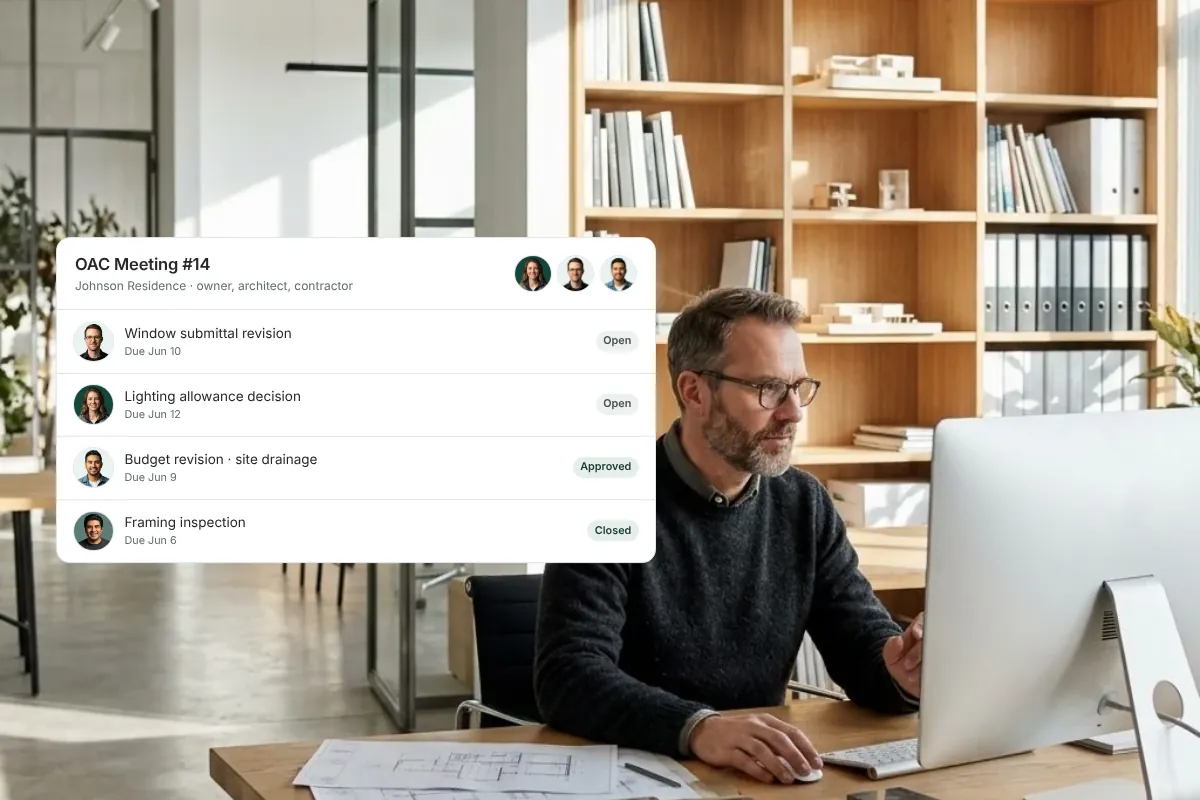
How to run an OAC meeting on a custom home: a standing agenda, owners and due dates for every open item, carry-forward items and minutes the whole team uses.

How to Build a Residential Construction Schedule
How to build a residential construction schedule: phase sequencing, lead times, buffer, selection deadlines, and a sample custom home timeline by phase.
Get started with Ally
Start with one project and expand as your business grows. No hidden fees, no long-term contracts.