
How to Run an Effective Owner–Architect–Contractor (OAC) Meeting on a Custom Home
Summary
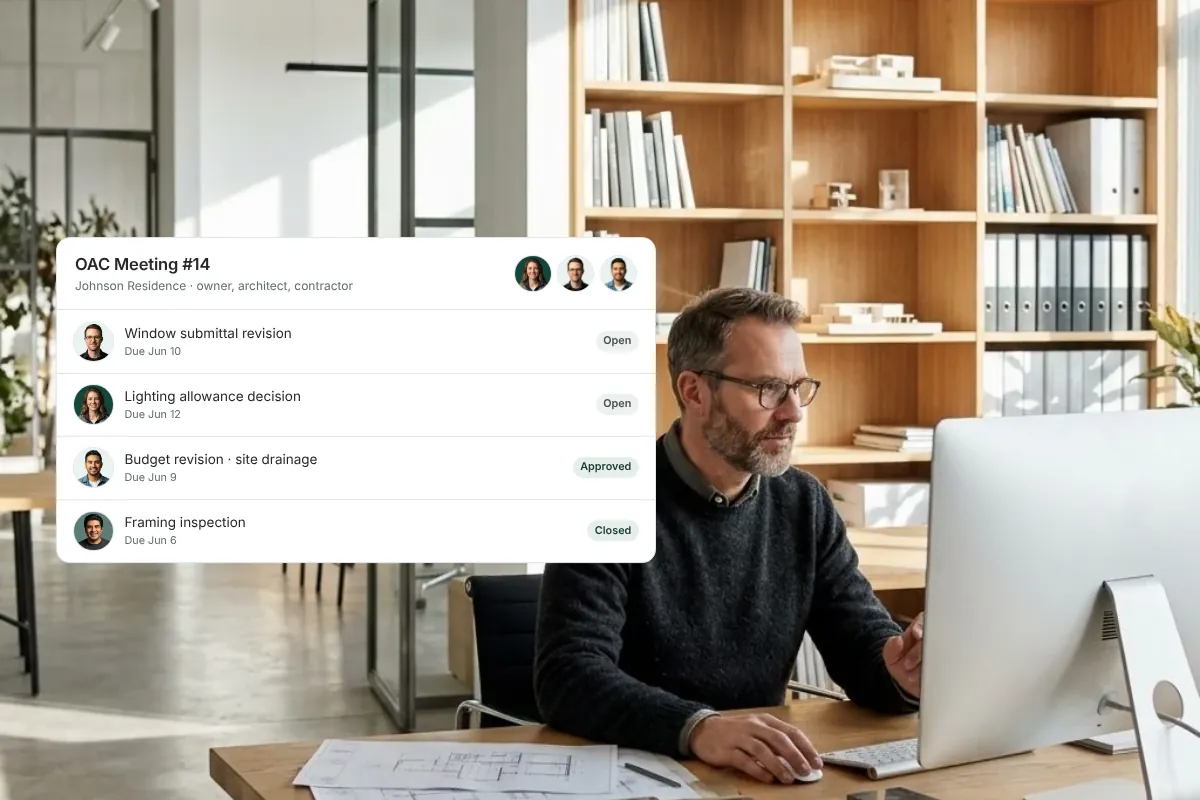
An effective OAC meeting works from a standing agenda and one running record of open items, each with an owner and a due date, carried forward until it’s closed. Decisions, approvals, budget changes and schedule issues are reviewed together, and the minutes become the reference everyone works from.
On this page
An effective owner–architect–contractor (OAC) meeting follows the same standing agenda every time and works from one running list of open items. Every item has a named owner and a due date and stays on the list until it’s closed. Decisions, approvals, budget changes and schedule issues are reviewed together, and the minutes are distributed promptly so the owner, architect, contractor and trades all work from the same record.
- Use a standing agenda so nothing important depends on someone remembering to raise it.
- Give every open item one owner and one due date. “Team” is not an owner.
- Carry items forward until they’re closed; never let them quietly disappear.
- Review decisions, budget changes and schedule impact in the same meeting, because they affect each other.
- Distribute minutes within a day, and treat them as the project’s working record.
What is an OAC meeting?
An OAC meeting is a recurring coordination meeting between the owner, the architect (and often the interior designer or other consultants) and the general contractor. On a custom home it’s where the people who make, design and build the decisions get on the same page: what’s been decided, what’s still open, what it costs and how it affects the schedule.
Done well, it’s the single most effective tool for team alignment on a custom home. Done poorly, it becomes a weekly conversation that nobody writes down, where the same questions come back every week.
How often should OAC meetings happen?
During active construction, most custom home teams meet weekly or every other week. Weekly works well through rough-ins and finishes, when decisions are dense; every other week can be enough during foundation and framing. What matters more than frequency is consistency: the same day, the same agenda, the same record.
A standing OAC meeting agenda
Keep it to 60–90 minutes. Send the agenda and the open-items list a day ahead so people come prepared.
- Review of last meeting’s open items (10–15 min). Walk the list. Each item is closed, updated with a new due date, or escalated.
- Schedule update (10 min). Progress since last meeting, the next two to four weeks, and any milestones at risk.
- Decisions and selections needed (15–20 min). What the owner or architect needs to decide, by when, and why that date matters.
- Approvals since last meeting (5 min). What was approved, with cost and schedule impact noted.
- Budget update (10 min). Changes since last meeting, pending items, current budget and projected final cost.
- Design questions and RFIs (10 min). Open questions between contractor and architect, with owners and dates.
- Site, quality and safety (5 min). Anything the owner should know about conditions on site.
- New items and wrap-up (5 min). Add new items to the list, confirm owners and dates, confirm the next meeting.
How to manage open items so they actually close
The open-items list is the heart of the OAC meeting. It turns discussion into accountability.
Give every item an owner and a due date
Each item should name one person responsible for the next step — the owner, the architect, the designer, the contractor or a specific trade — and the date it’s needed. If the next step belongs to two people, split it into two items.
Carry items forward until closed
An item stays on the list, with its original date and history, until it’s resolved. Moving the date is fine; deleting the item because it’s uncomfortable is not. Seeing that an item has been open for six weeks is useful information.
Record the outcome, not just the discussion
When an item closes, note what was decided and its cost and schedule impact. “Discussed tile” helps nobody. “Owner selected Option B tile; adds $3,200; no schedule impact; approval sent” is a record.
Sample open-items log
| # | Item | Owner | Due | Status |
|---|---|---|---|---|
| 14 | Select primary bath tile and layout | Owner | Oct 1 | Open (2nd meeting) |
| 15 | Revised beam detail at kitchen opening | Architect / engineer | Sep 26 | Closed — detail issued Sep 24 |
| 16 | Pricing for added pantry shelving | Contractor | Sep 29 | Open — pricing authorized, not work |
| 17 | Confirm appliance package and delivery window | Owner / designer | Oct 8 | Open |
| 18 | Exterior paint color sample on site | Contractor | Oct 3 | Open |
Note item 16: the owner authorized pricing, not the work itself. Keeping that distinction visible avoids misunderstandings about what was approved. For more on this, see keeping homeowner selections moving without losing track of what was approved.
Who runs the meeting?
On most custom homes, the contractor’s project manager runs the OAC meeting, because they hold the schedule, the budget and the open-items list. Clear roles keep the meeting from drifting:
- Facilitator (usually the contractor’s PM): keeps to the agenda, walks the open-items list and makes sure every new item leaves the room with an owner and a date.
- Note-taker: records decisions, outcomes and changes to the list in real time. Ideally not the facilitator.
- Architect or designer: answers design questions, takes ownership of drawing and specification items, and confirms design intent.
- Owner: makes or schedules the decisions that are theirs, and raises priorities and concerns early.
If a topic needs more than five minutes of problem-solving, assign it as an item with an owner and a date and move on. The meeting is for coordination and decisions, not for working through every detail live.
What should OAC meeting minutes include?
- Date, attendees and project.
- The updated open-items list with owners, due dates and status.
- Decisions made in the meeting, with cost and schedule impact.
- Approvals still required, and from whom.
- Schedule status and any milestones at risk.
- Budget changes discussed, with current budget and projected final cost (see tracking current financial position and projected final cost).
- Next meeting date.
Send minutes within one business day. Ask attendees to flag corrections within a set window (for example, two business days); after that, the minutes stand as the record.
Common OAC meeting problems
- Decisions made in the meeting but never documented. If an approval matters, capture it in your approval process, not only in the minutes.
- The schedule and budget discussed separately. A selection that costs more and takes longer to arrive affects both; review them together.
- Minutes as a separate document nobody opens. When minutes live apart from the project’s actual approvals, budget and schedule, they drift out of sync.
- Too many people, too little structure. Invite trades for specific items rather than the whole meeting.
How Ally keeps the OAC record tied to the project
Ally has an OAC view built for exactly this meeting. Items flagged for discussion come from the project itself, so the agenda reflects real open tasks and decisions rather than a separately maintained list. Meetings and their summaries are kept with the project, and items that were previously discussed stay visible until they’re resolved.
Because approvals, the budget and the schedule live in the same place, the OAC record stays tied to what was actually approved, what it cost and when the work happens — instead of becoming one more document to keep in sync. Owners can see the same information between meetings, which keeps the whole team aligned.
Frequently asked questions
What is an OAC meeting in construction?
An owner–architect–contractor meeting is a recurring coordination meeting where the owner, design team and builder review progress, open decisions, approvals, budget changes and the schedule. On custom homes it’s the main forum for keeping the team aligned.
What should be on an OAC meeting agenda?
Review of open items, schedule update, decisions and selections needed, recent approvals, budget update, design questions and RFIs, site issues, and new items with owners and due dates. Using the same agenda every time keeps meetings efficient.
Who should attend an OAC meeting?
The owner (or their representative), the architect, the general contractor’s project lead, and consultants such as the interior designer when their items are on the agenda. Bring trades in for specific items rather than the whole meeting.
How do you write OAC meeting minutes?
Record attendees, decisions with cost and schedule impact, the updated open-items list with owners and due dates, approvals still needed, and the next meeting date. Distribute within one business day and give attendees a short window to correct them.
How long should an OAC meeting take?
Usually 60–90 minutes. If meetings regularly run longer, the open-items list probably isn’t being worked between meetings, or too many topics are being solved live instead of assigned.
See how Ally ties OAC meetings to real approvals, budget and schedule: book a demo.
Related resources

What to Tell a Homeowner When the Construction Schedule Gets Delayed
What to tell a homeowner when a construction schedule slips: a simple framework, sample scripts for each type of delay, and how to document the cause.
How to Coordinate Subcontractors So Trades Show Up When You Need Them
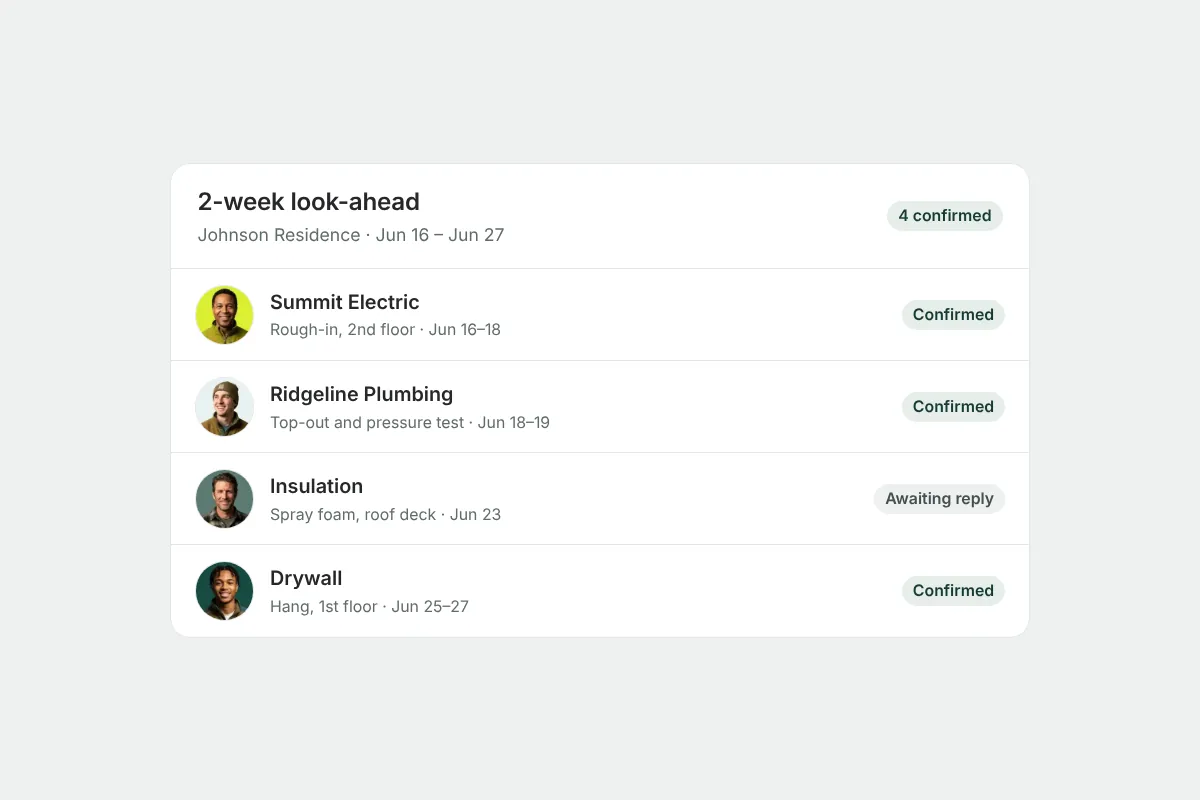
How to coordinate subcontractors on a custom home: confirmations, a two-week look-ahead schedule, change notifications and clear ownership so trades show up.

How to Build a Residential Construction Schedule
How to build a residential construction schedule: phase sequencing, lead times, buffer, selection deadlines, and a sample custom home timeline by phase.
Get started with Ally
Start with one project and expand as your business grows. No hidden fees, no long-term contracts.