
How to Keep Homeowner Selections Moving Without Losing Track of What Was Approved
Summary
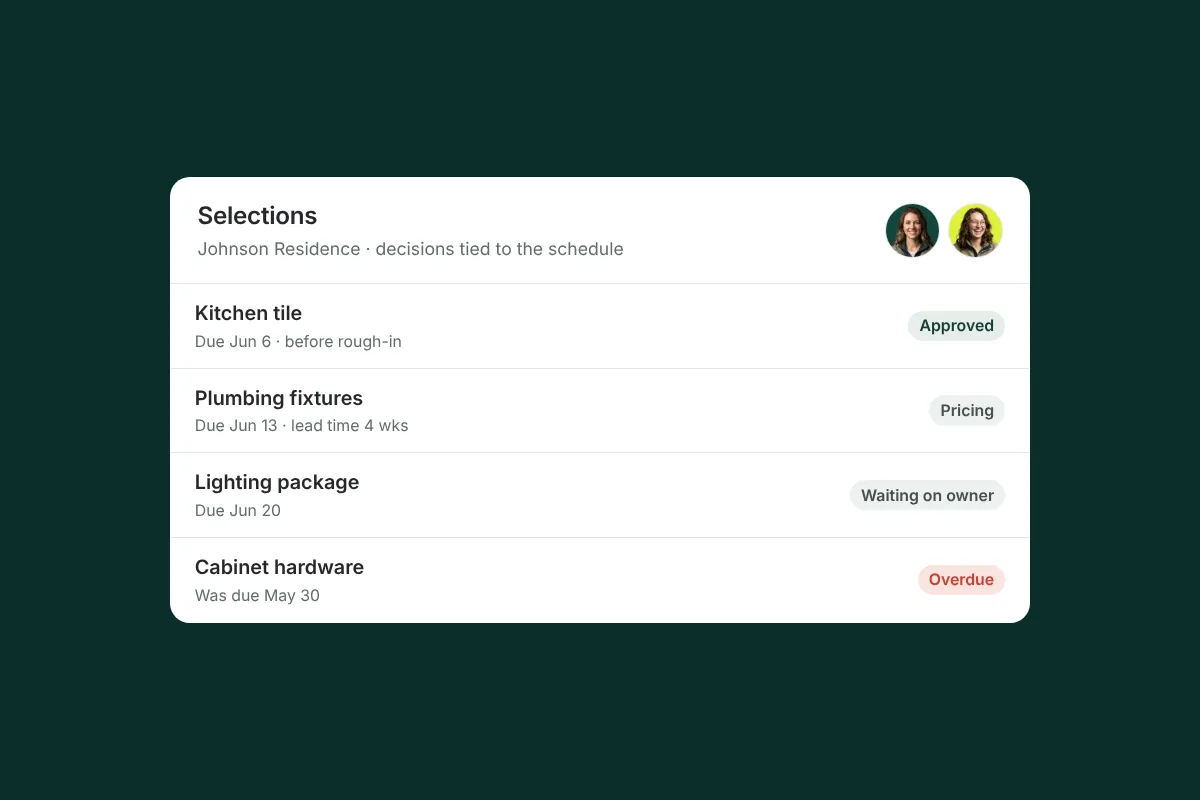
Selections slow down when the homeowner has too many options, no deadline and no clear ask. A good process assigns each decision an owner and a schedule-based deadline, separates approval to price from approval to proceed, and records exactly what was approved with its cost and schedule impact.
On this page
To keep homeowner selections moving, give every decision a named owner, a deadline tied to the construction schedule and a clear description of what you need from them. Then record exactly what they approved, what it costs and how it affects the schedule. Clients rarely decide slowly on purpose. They decide slowly when the ask is vague and nobody is accountable for the next step.
Key takeaways
- Selections stall for predictable reasons: too many options, no deadline, scattered communication and an unclear ask.
- Every selection needs an owner, a “decide by” date driven by lead times and the schedule, and a defined scope.
- Separate authorization to develop pricing from authorization to proceed with the work.
- The approval record matters more than the speed: who decided, what version, what it costs and what it does to the schedule.
- One shared place for selections keeps the owner, architect and contractor working from the same information.
Why are homeowners slow to approve selections?
On a high-end custom home, the homeowner might make two or three hundred decisions between design development and closeout. Most of them are made by people who have never built a house before, while they are also running a business or a family. Delays usually come from the process, not the person.
Too many options, not enough framing
Sending a homeowner to a showroom with a $6,000 plumbing fixture allowance and “pick what you like” invites weeks of browsing. Clients decide faster when they see two or three curated options from the designer or architect, each with the price, the lead time and what changes if they pick it.
No deadline, or a deadline nobody believes
“We need tile soon” is not a deadline. A deadline tied to a real event (“tile must be ordered by March 14 so it arrives before the tile setter starts on April 21”) is one people respect. When the date comes from the schedule and the supplier’s lead time, it stops feeling arbitrary.
Approvals scattered across text, email and site walks
A “looks good” text, a comment on a drawing markup and a nod during a walkthrough are three versions of the same decision living in three places. When they disagree, the project team spends hours reconstructing what was actually agreed, and the homeowner loses confidence that anyone is keeping track.
The homeowner doesn’t know what is being asked
Is the contractor asking them to choose a product, approve a price, or authorize work? Those are different decisions. When the ask is unclear, careful clients wait, because waiting feels safer than committing to something they don’t fully understand.
Approval to price vs. approval to proceed
Many selection disputes start because two different authorizations get treated as one. On a cost-plus custom home in particular, keep them separate:
- Authorization to develop pricing. The homeowner likes a direction (say, a steam shower in the primary bath) and asks you to price it. You and your trades spend time on takeoffs and quotes. Nothing is ordered and no work is done.
- Authorization to proceed. The homeowner has seen the price and the schedule impact and approves the work. Now you order, schedule trades and commit costs.
Recording these as two steps protects both sides. The homeowner never feels pushed into a commitment they didn’t understand, and you have a clear record that the work was authorized once the cost and schedule impact were known. If pricing itself takes significant design or estimating time, say so up front and agree how that time is handled under your contract.
A step-by-step selections approval process
This is a practical workflow residential builders use to keep decisions moving while keeping the record clean.
1. Build the selections list during preconstruction
List every owner decision for the project, grouped by phase. Our custom home selections checklist is a good starting point. Mark which items are allowances, which are already specified on the drawings and which are open.
2. Work backward from the schedule to set “decide by” dates
For each selection, take the date the material must be on site, subtract the supplier’s lead time and your ordering buffer, and that is the latest decision date. Long-lead items (windows, custom cabinetry, specialty tile, appliances) often need decisions months before anyone touches them on site.
3. Assign an owner to every decision
The homeowner makes the final call, but someone on your team owns getting it made: preparing options, answering questions and following up. If the architect or interior designer is presenting options, note that too. Accountability means everyone knows who is responsible for the next step.
4. Send a clear, complete request
Each request should include the item, the options (with photos and specs), the price or allowance impact, the lead time, the decision date and exactly what you are asking for: a choice, approval to price, or approval to proceed.
5. Record the decision with its impact
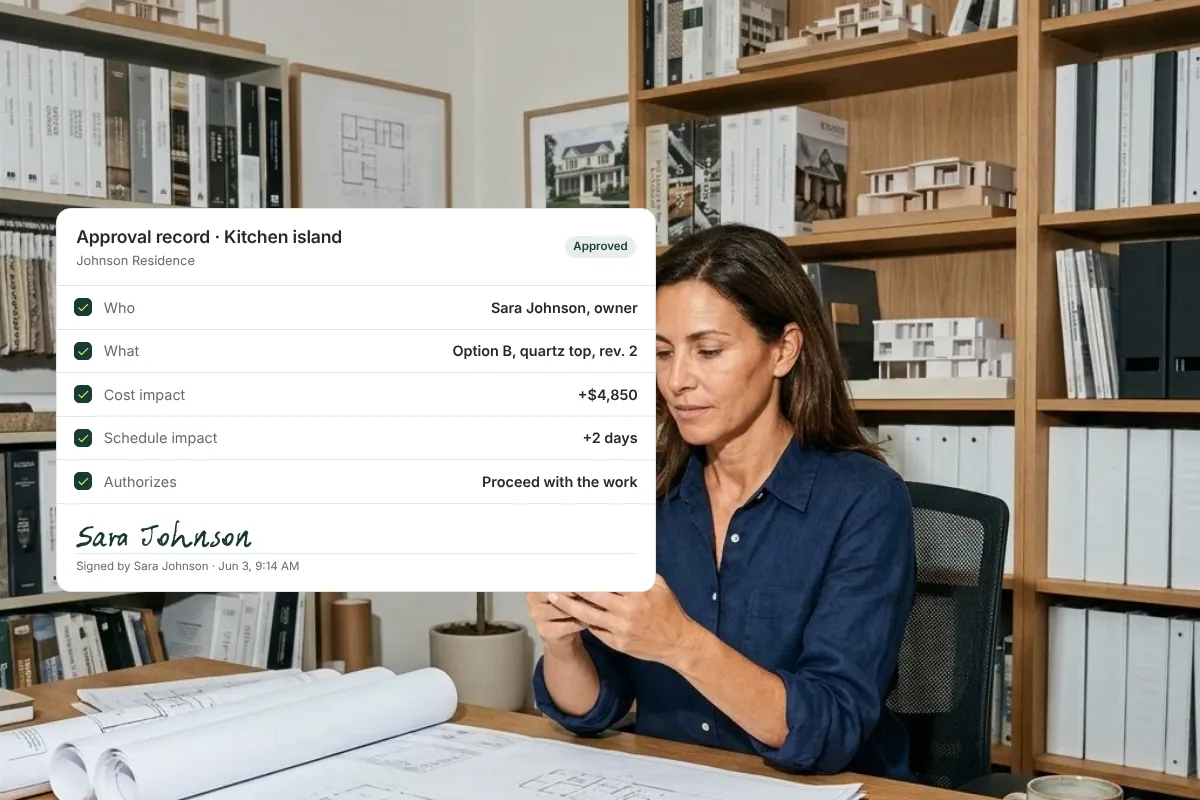
When the homeowner decides, capture who approved it, the date, the specific product or version and the resulting cost and schedule impact. See how to properly document owner approvals for what a complete record includes.
6. Follow up before the deadline, not after
Reminders a week and a few days before the decision date keep things moving without nagging. If a deadline is going to slip, flag the schedule consequence early so the homeowner can choose: decide now, or accept the delay.
7. Review open decisions at every owner meeting
Open selections belong on the standing agenda of your owner–architect–contractor meeting, with the owner and due date for each. Our guide to running an effective OAC meeting covers how to carry items forward until they are closed.
What a selection request should look like
| Field | Example |
|---|---|
| Item | Primary bathroom floor tile |
| Options | A: 24×48 porcelain, matte limestone look. B: Honed marble hex mosaic. |
| Cost impact | Allowance $9,000. A: $7,800 installed (under by $1,200). B: $14,600 installed (over by $5,600). |
| Lead time | A: 2 weeks. B: 8–10 weeks. |
| Decide by | March 14 (tile setter starts April 21) |
| Decision owner | Homeowner; questions to the project manager or interior designer |
| What we’re asking for | Choose an option and approve it to proceed (order and install) |
A request like this is easy to decide on because it answers the homeowner’s real questions before they have to ask them. It is also easy to defend later, because the price and lead time were on the page when they chose.
How to handle late or changed decisions
Late decisions happen. The goal is to make the consequence visible, not to punish anyone. When a deadline passes, tell the homeowner what it now affects: a trade that has to be rescheduled, a storage cost, an extended general conditions period on a cost-plus job. If they change a decision that was already approved, treat it as a new decision with its own cost and schedule impact, and record it the same way. Our post on what to do when a homeowner keeps changing their mind mid-build covers the conversation in more detail.
When a late decision does push the schedule, the record of who owned the decision and when it was requested lets you explain the delay factually, without assigning blame in the moment. See what to tell a homeowner when the schedule gets delayed.
How Ally keeps selections moving and documented
Ally gives you one place to send, discuss and document every decision a homeowner needs to make. Selections, allowances and change orders go to the client’s phone or computer with photos and details, and they can ask questions and approve in the same place. Ally follows up automatically on pending approvals, so decisions don’t depend on someone remembering to chase them.
Every approval is logged with a timestamp in a searchable record, so the owner, architect and your team can see what was approved, by whom and when, and how it affects the budget. Learn more about client approvals in Ally.
Frequently asked questions
How do I get homeowners to make selections faster?
Give them fewer, better-framed options, each with price and lead time, and a decision date that comes from the schedule. Assign someone on your team to own each decision and follow up before the date. Clients decide faster when they understand exactly what they are being asked and what happens if they wait.
What is a reasonable selections deadline on a custom home?
Work backward from when the material must be on site: subtract the supplier’s lead time and an ordering buffer of one to two weeks. Long-lead items such as windows, custom cabinets and specialty tile often need decisions two to four months before installation, while paint colors can wait until shortly before painting.
Why are my clients slow to approve selections?
Usually because the process is unclear, not because they are indecisive. Common causes are open-ended options, no real deadline, approvals spread across texts and emails, and uncertainty about whether they are approving a choice, a price or the work itself. Fixing those four things resolves most delays.
Should a homeowner approve the price before the selection is ordered?
Yes. Separate approval to develop pricing from approval to proceed. The homeowner first chooses a direction, you price it, and only after they have seen the cost and schedule impact do they authorize the order. That sequence keeps them informed and gives you a clear record of what was authorized.
Who should own the selections process: the contractor or the designer?
The homeowner makes the final decision, but each selection should have one named person responsible for getting it made. That might be your project manager, the interior designer or the architect, depending on the item. What matters is that everyone knows who owns the next step.
Want to see how documented approvals work in practice? Book a demo and we’ll walk through a real selections workflow.
Related resources
How to Properly Document Owner Approvals on a Custom Home
A “sounds good” text is weak proof. Learn what a properly documented owner approval includes: who, what, when, version, cost and schedule impact.

The Custom Home Selections Checklist: Every Decision Your Client Needs to Make (and When)
A phase-by-phase custom home selections checklist: every owner decision and the latest point it can be made without delaying the build schedule.
Spreadsheet vs. Project Management Software for Small Residential Builders: When to Switch
An honest comparison of spreadsheets vs. construction project management software for small residential builders, and the signs it’s time to switch.
Get started with Ally
Start with one project and expand as your business grows. No hidden fees, no long-term contracts.