
How to Properly Document Owner Approvals on a Custom Home
Summary
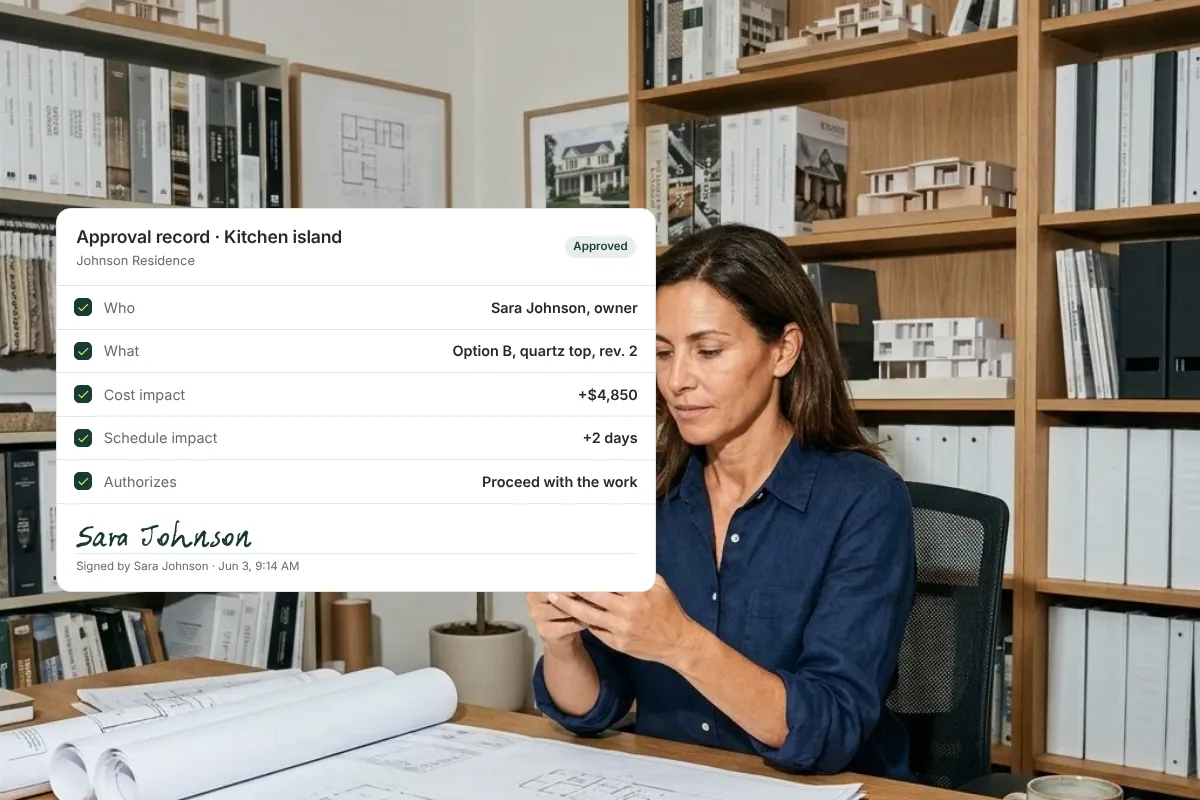
Most approval disputes start because the decision, its cost and its schedule impact were never laid out clearly. A properly documented approval records who approved, exactly what and which version, when, the cost and schedule impact, and whether it authorized pricing or the work itself.
On this page
- Key takeaways
- Prevention first: why approval disputes start
- Are text message approvals binding?
- What does a properly documented approval include?
- Authorization to price vs. authorization to proceed
- Approval record checklist
- Where should approvals live?
- How Ally documents owner approvals
- Frequently asked questions
A properly documented owner approval records six things: who approved, exactly what they approved (including the version), when, the cost impact, the schedule impact, and whether they authorized pricing or the work itself. A “sounds good” text captures almost none of that. The best protection, though, comes before the signature: lay out the decision and its impact clearly so there is nothing to dispute later.
Key takeaways
- Most approval disputes start because the decision, its cost and its schedule impact were never presented clearly.
- A text or verbal “yes” is weak documentation: it rarely says what version, what price or what it authorizes.
- A complete approval record answers who, what, when, which version, cost impact, schedule impact and scope of authorization.
- Keep approvals in one searchable record tied to the budget and schedule, not scattered across phones and inboxes.
This is general information, not legal advice; check your contract and state law.
Prevention first: why approval disputes start
When a homeowner says “I never agreed to that,” they are rarely lying. More often, they agreed to something slightly different from what the contractor understood. They approved the tile but not the upgraded setting materials. They approved the window change but didn’t realize it pushed framing inspection by two weeks. They approved pricing a pool house but not building it.
The fix is to present every decision the same way, with its consequences visible before anyone says yes:
- What is being decided, described specifically enough that two people couldn’t picture different things.
- What it costs, relative to the current budget or allowance.
- What it does to the schedule, including lead times and any trades that move.
- What the approval authorizes: developing pricing, or proceeding with the work.
When a homeowner approves with all four in front of them, disputes become much less likely, because the record shows what they saw when they decided. That is transparency and accountability working together.
Are text message approvals binding?
Text and email approvals can be evidence that a conversation happened, and in some situations they may be treated as written agreement. Whether a particular text satisfies your contract’s requirements for changes or approvals depends on the contract language and your state’s law. The practical problem is different: even when a text is admissible, it is usually weak documentation.
Consider a typical exchange:
Builder: “Can we go with the upgraded hardware package?”
Homeowner: “Sounds good 👍”
Which hardware package? At what price? Did they understand it adds three weeks of lead time to the cabinet install? Were they approving the price, or just the look? Six months later, both sides will remember the exchange differently, and the text won’t settle it.
Verbal approvals on a site walk have the same weakness with even less evidence. If you rely on them, follow up the same day with a written summary and ask the homeowner to confirm it through your normal approval process.
What does a properly documented approval include?
| Element | Why it matters | Example |
|---|---|---|
| Who approved | Confirms the decision came from someone authorized to make it under the contract | Sara Johnson, owner |
| What was approved | Removes ambiguity about the product, scope or option | Kitchen island upgrade: walnut end panels and waterfall quartz edge |
| Which version | Drawings, quotes and selections change; the record must point to the one approved | Cabinet shop quote rev. C, dated June 2 |
| When | Establishes the sequence of decisions and whether a deadline was met | June 3, 9:14 AM |
| Cost impact | Shows the owner knew the financial consequence | +$4,850 to cabinetry budget |
| Schedule impact | Shows the owner knew the time consequence | Cabinet install moves from June 12 to June 16 |
| Scope of authorization | Separates permission to price from permission to proceed | Approved to proceed: order and install |
| Supporting documents | Lets anyone reconstruct the decision later | Quote, drawing markup, product spec sheet |
Authorization to price vs. authorization to proceed
Treat these as separate, recorded approvals. When a homeowner asks “what would it cost to add a covered outdoor kitchen?”, record that they authorized you to develop pricing. When they’ve reviewed the number and schedule impact and say “let’s do it,” record that they authorized the work. On cost-plus projects this distinction is especially important, because costs start accruing the moment trades mobilize. If developing pricing requires real design or estimating time, make sure the homeowner knows that before you start, consistent with your contract.
Approval record checklist
Use this checklist before you treat any owner decision as approved:
- The decision is described specifically (product, model, finish, quantity, location).
- The approved version of drawings, quotes or specs is referenced or attached.
- The cost impact is stated against the current budget or allowance.
- The schedule impact is stated, including lead times and affected trades.
- The approval says whether it authorizes pricing or the work.
- The approver is identified and is authorized to approve under the contract.
- The date and time of approval are recorded.
- The approval is captured in writing through your standard process, not only in a text thread.
- The approved item is reflected in the budget, the schedule and the relevant purchase or subcontract.
- The architect or designer is informed when the decision affects their scope.
Where should approvals live?
An approval is only useful if you can find it. If approvals live in a project manager’s phone, a superintendent’s notebook and a dozen email threads, you will spend hours reconstructing them, usually at the worst possible moment: when there is a disagreement over an invoice.
Keep every owner approval in one searchable record that is tied to the project budget and schedule. The owner, architect and contractor should all be able to see the same history: what was decided, when, and what it changed. That shared record is what keeps a team aligned when memories differ.
For changes that adjust cost, the type of change matters too. Not every cost adjustment needs a formal change order. Our guide to change orders vs. budget revisions explains which documentation fits which situation.
How Ally documents owner approvals
Ally presents each decision with its details up front, so the homeowner sees what is being decided and its impact before they approve. Selections, allowances and change orders go to the client’s phone or computer with photos and details; they can review, ask questions and sign off digitally.
Every approval is logged with a timestamp and stored in a searchable record, so you can pull up exactly what was approved, by whom and when. Approved change orders flow into the budget and schedule, so the record and the project numbers stay in sync. See how it works on our client approvals page, and for keeping decisions moving in the first place, read how to keep homeowner selections moving.
Frequently asked questions
Are text message approvals legally binding in construction?
Sometimes a text can count as written agreement, but it depends on your contract’s change and approval provisions and your state’s law. Even when admissible, texts are weak documentation because they rarely state the exact item, version, price, schedule impact or what was authorized. This is general information, not legal advice.
How do I document client approvals in construction?
Present the decision with its cost and schedule impact, then capture a written approval that records who approved, what and which version, when, and whether it authorizes pricing or the work. Store it in one searchable project record tied to the budget and schedule, with the supporting quote or drawing attached.
What counts as proof of homeowner approval in a dispute?
The strongest proof is a dated, signed approval that describes the specific item and version, states the cost and schedule impact, and shows what was authorized, with supporting documents attached. A consistent process applied to every decision is more persuasive than a one-off text or a verbal recollection.
Can homeowners sign construction selections digitally?
Yes. Digital sign-off is common and practical for selections, allowances and change orders, provided the record captures who signed, when, and exactly what they approved. Check that your contract allows electronic approvals; most modern residential contracts do.
Should I document verbal approvals from a site walk?
Yes, the same day. Send a written summary of what was decided, the cost and schedule impact, and ask the homeowner to confirm it through your normal approval process. Don’t proceed with work that changes cost or schedule on a verbal approval alone.
See how Ally keeps every decision documented for the whole team. Book a demo.
Related resources
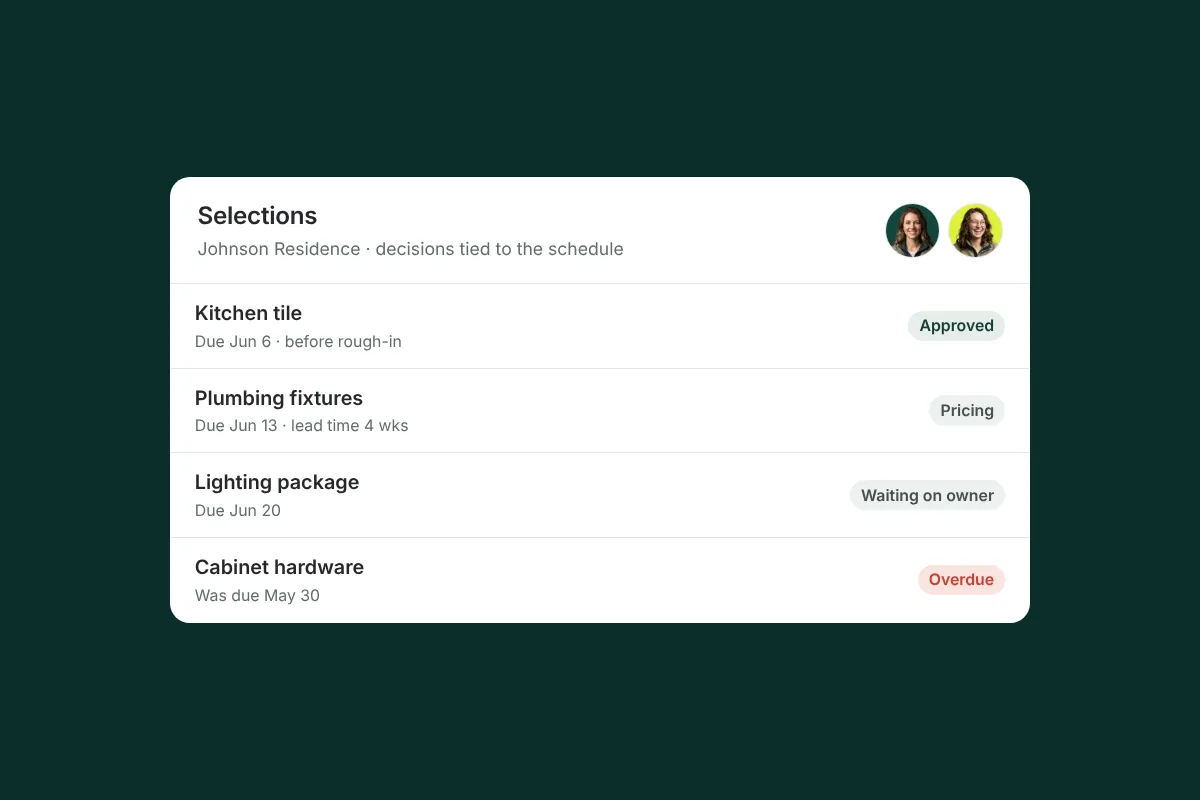
How to Keep Homeowner Selections Moving Without Losing Track of What Was Approved
Homeowner selections stall when nobody owns the decision. Set a deadline tied to the schedule, record exactly what was approved and its cost impact.

The Custom Home Selections Checklist: Every Decision Your Client Needs to Make (and When)
A phase-by-phase custom home selections checklist: every owner decision and the latest point it can be made without delaying the build schedule.
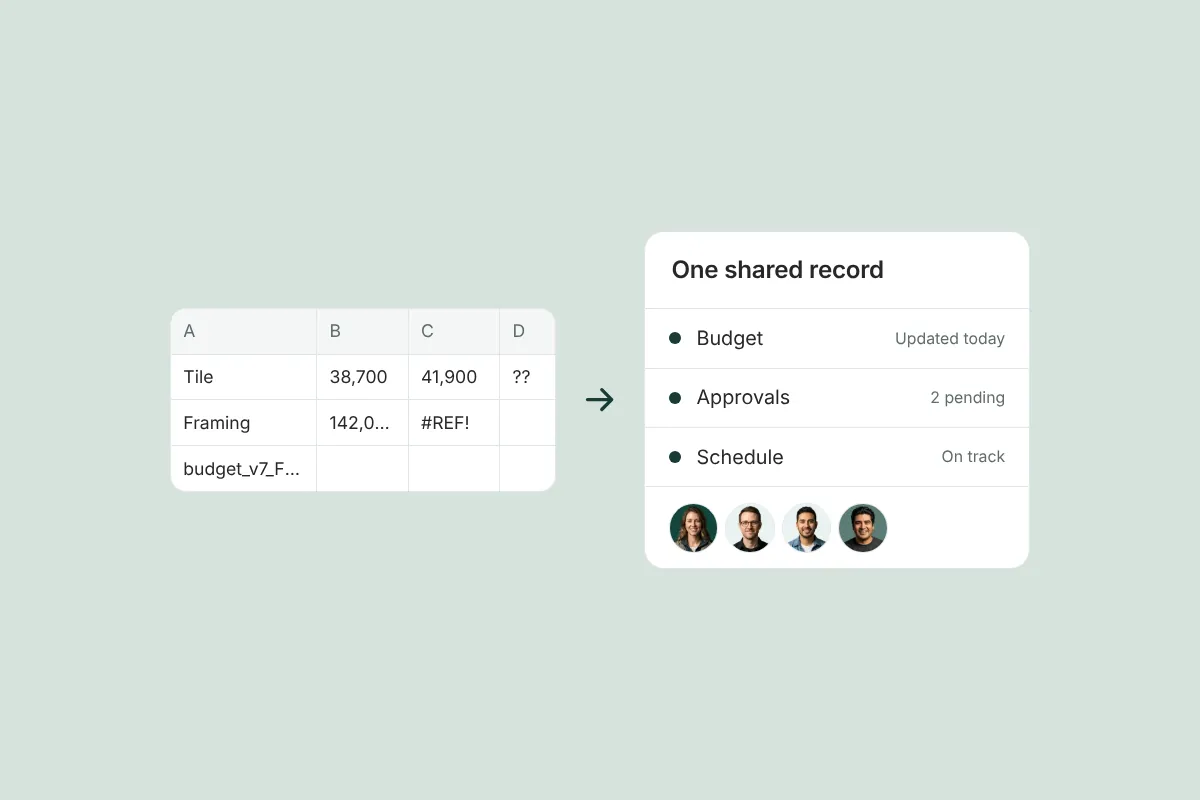
Spreadsheet vs. Project Management Software for Small Residential Builders: When to Switch
An honest comparison of spreadsheets vs. construction project management software for small residential builders, and the signs it’s time to switch.
Get started with Ally
Start with one project and expand as your business grows. No hidden fees, no long-term contracts.