
How to Collect and Track Lien Releases from Subs and Suppliers

Summary
Lien releases are your primary defense against costly title disputes and lawsuits. To stay protected, you must integrate waivers into your payment workflow: never release funds without a signed conditional waiver, and always follow up for an unconditional release once payment clears. Automating this through a project management tool ensures you never reach a project closeout with a dangerous gap in your paper trail.
On this page
- What is a lien release and why does it matter for residential GCs?
- How to set up a lien release workflow before the project starts
- What to collect at each payment milestone
- How to track lien releases across multiple subs and projects
- What to do when a sub or supplier won't return a lien release
- How to organize lien release documents for project closeout
Lien releases are one of those things that feel like paperwork until the day they become a lawsuit. If you've been building long enough, you've probably already felt that sting once. A sub gets paid, moves on to the next job, and six months later you're getting a call from your client saying there's a lien on the title and the closing on their refi just blew up. That's the moment when "I thought we handled that" turns into a very expensive problem.
Getting lien releases right isn't complicated, but it does require a consistent process. Here's how to build one that actually holds up on every project.
What is a lien release and why does it matter for residential GCs?
A lien release (also called a lien waiver) is a document where a contractor, subcontractor, or supplier gives up their right to file a mechanic's lien against a property in exchange for payment. Think of it as a receipt that says "I've been paid and I'm not coming after the owner's property for this amount."
On a custom home project, you could have anywhere from 10 to 40 different subs and suppliers involved. Each one of them has lien rights. Your framer, your window supplier, your electrical sub, the concrete guy, the lumber yard, all of them can place a lien on the property if they feel they weren't paid. That lien attaches to the title and can block a sale, a refinance, or a final loan draw. Homeowners care about this a lot, and title companies care even more.
There are two main types to know. A conditional lien release says "I waive my lien rights once this payment actually clears." A unconditional lien release says "I've already been paid and I'm giving up my rights now." The conditional version protects you before the check clears. The unconditional version is what you collect after everything settles. Most GCs use both at different stages of the project, which is exactly the right approach.
How to set up a lien release workflow before the project starts
The easiest way to make lien releases a non-event on your projects is to bake them into your subcontractor agreements from day one. Before a sub swings a hammer, your contract should spell out that lien releases are required as a condition of payment. No release, no check. That's it. When it's in the contract, nobody can act surprised when you ask for it.
You also want to have your lien release templates ready to go before the project kicks off. Most states have statutory forms that are legally required, so don't just pull a generic template from the internet. Pull your state's required form, have your attorney review it once, and then use that version every time. California, Texas, Florida, and most other states with heavy construction activity have very specific requirements, and a non-compliant form can be challenged.
Set up a simple tracking log early. You need to know at a glance which subs and suppliers have pending releases, which ones have been returned, and which draws are being held up because a release is missing. A spreadsheet works until you have multiple projects running at once, and then it starts to fall apart fast.
What to collect at each payment milestone
The clearest structure is to tie lien release collection directly to your draw schedule. Every time you submit a pay application or cut a check, you're either requesting a release or collecting one. Here's how that typically breaks down on a residential build.
When you're processing a progress payment to a sub, you send a conditional lien waiver covering the amount of that payment and ask the sub to sign and return it before you release the funds. Some GCs send the signed waiver with the check and make endorsement of the check conditional on returning the signed document. That's a clean approach that works well in practice.
Once the check has cleared and you've confirmed payment, you follow up and collect an unconditional lien waiver for that same payment amount. This is the one that actually protects you and the owner because it's not conditional on anything anymore. A lot of GCs skip this step and only hold conditional waivers, which leaves a gap in the paper trail.
At final payment, you collect an unconditional final lien waiver from every sub and supplier who touched the job. This is your last line of defense before you close out the project and submit your final pay app to the owner. Some lenders require these before releasing the final draw, so having them ready saves you from a last-minute scramble.
How to track lien releases across multiple subs and projects
The tracking problem is where most GCs struggle. You've got a framing sub who sent a conditional on draw three but never sent the unconditional. You've got a window supplier who's claiming they never received the waiver request. You've got a plumber who signed the wrong form. By the time you hit closeout, you're chasing down six different loose ends while also managing a punch list and trying to get your final inspection scheduled.
The fix is a centralized tracking system that ties lien releases directly to payment events. Every time a payment is processed, the system should flag the associated waiver as pending and stay on it until the signed document is back in your hands. This is exactly the kind of workflow that gets lost when you're managing everything through email and a spreadsheet.
Platforms like Ally are built specifically for residential GCs and include lien release management as part of the broader project workflow. Instead of tracking waivers in a separate spreadsheet that nobody updates consistently, you can manage them right alongside your pay applications, billing, and client approvals. When a draw is processed, the lien release step is part of that same flow, not a separate task you have to remember to do. That kind of integration is what keeps you from closing out a $1.2M home build and realizing you're missing three unconditional waivers from subs you paid four months ago.
Ally also connects with QuickBooks, so your payment data and your lien release tracking stay in sync without anyone having to manually reconcile two different systems. For GCs managing multiple projects at once, that connection between financial records and document tracking is a real time saver.
What to do when a sub or supplier won't return a lien release
This happens, and it's usually one of two situations. Either the sub is disorganized and just keeps forgetting, or the sub has a dispute about payment and is using the lien release as leverage. Both require a different approach.
For the disorganized sub, the solution is friction reduction. Make it as easy as possible to sign and return. Send the document via email with a clear subject line, follow up with a text, and make the return process simple. If you're using a platform that supports electronic signatures—like Ally—use it. A sub standing on a job site at 7am is much more likely to sign on their phone than to print, sign, scan, and email a PDF back to you.
For the sub who's using the release as leverage, you need to get to the bottom of the dispute quickly. If there's a legitimate billing disagreement, work it out. If the sub is claiming they weren't paid when your records show they were, you'll be glad you have payment documentation that ties directly to your lien release requests. That paper trail is what protects you in a dispute.
If a sub or supplier flat out refuses to provide a release after confirmed payment, talk to your construction attorney. Some states have statutes that allow you to pursue damages if someone wrongfully withholds a lien waiver after receiving payment.
How to organize lien release documents for project closeout
By the time you're wrapping up a project, you should have a complete file that includes a conditional and unconditional waiver for every draw, from every sub and supplier who was paid anything on the job. That file is what you hand to the title company, what you reference if anyone raises a dispute after the project closes, and what protects your client's title for years to come.
Organize the file by sub or supplier name, and within each folder, organize by draw number and date. If you're doing this digitally (and you should be), store everything in a project management platform that keeps documents attached to the relevant pay event. That way, anyone on your team can pull up draw three for the framing sub and immediately see both the payment record and the associated lien releases without digging through email.
Ally's file management and pay application features work together so that your lien release documents live right next to the billing records they're tied to. When your project coordinator needs to pull together a closeout package, they're not searching through email threads or shared drives looking for a signed PDF from six months ago. It's all in one place, organized the way it should be.
Lien releases aren't glamorous, but they're one of the few things in this business where a clean process pays for itself directly. One missed release on a high-end custom home can tie up a closing, damage your client relationship, and cost you far more in legal fees than any reasonable system would have cost to maintain. Build the habit early, tie it to your payment workflow, and make sure your whole team knows the rule: no release, no draw.
Ready to get started and say goodbye to running your construction business on spreadsheets? Start your trial today at allyprojectmanagement.com.
Related resources
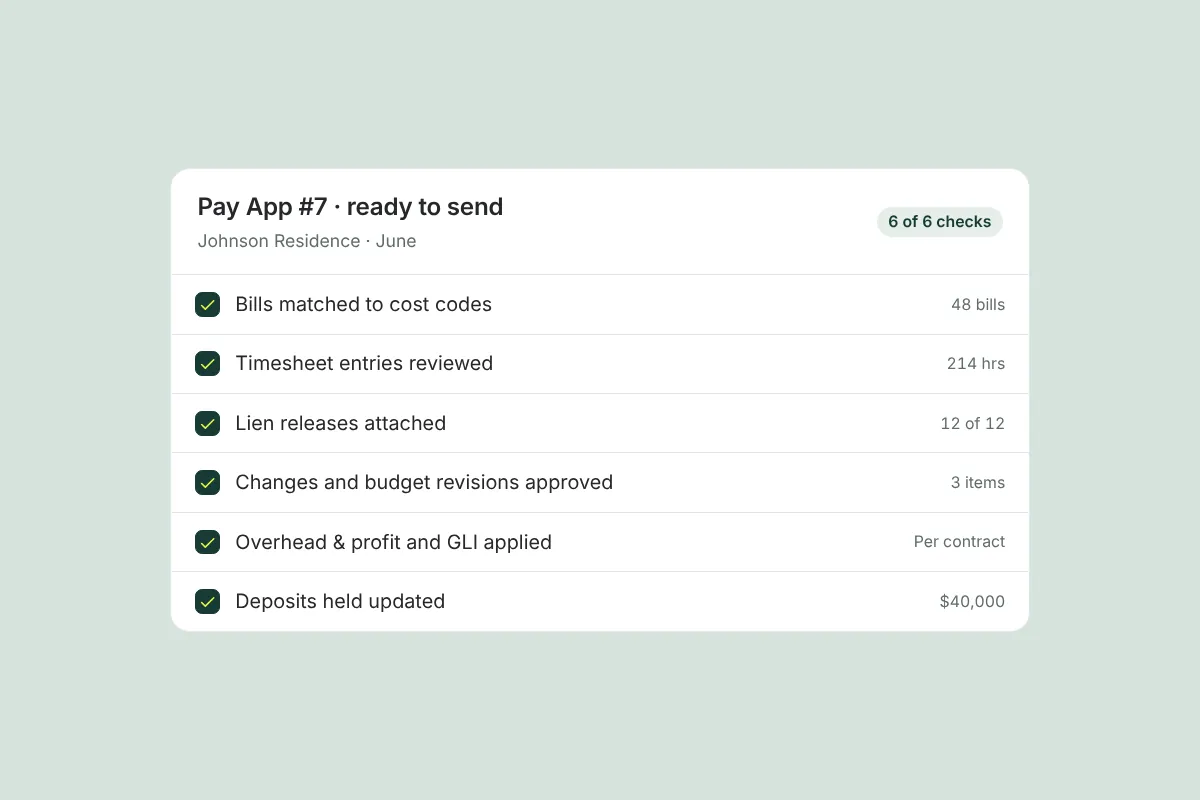
How to Prepare Accurate, Fully Documented Pay Applications
A pre-submission checklist for custom home pay applications: matched invoices, lien releases, approved changes, honest percent complete and clean math.

Retainage in Residential Construction: How It Works and How to Track It
Retainage is a share of each payment held back until the work is complete. Learn typical rates, when it’s released and how to track it on a custom home.
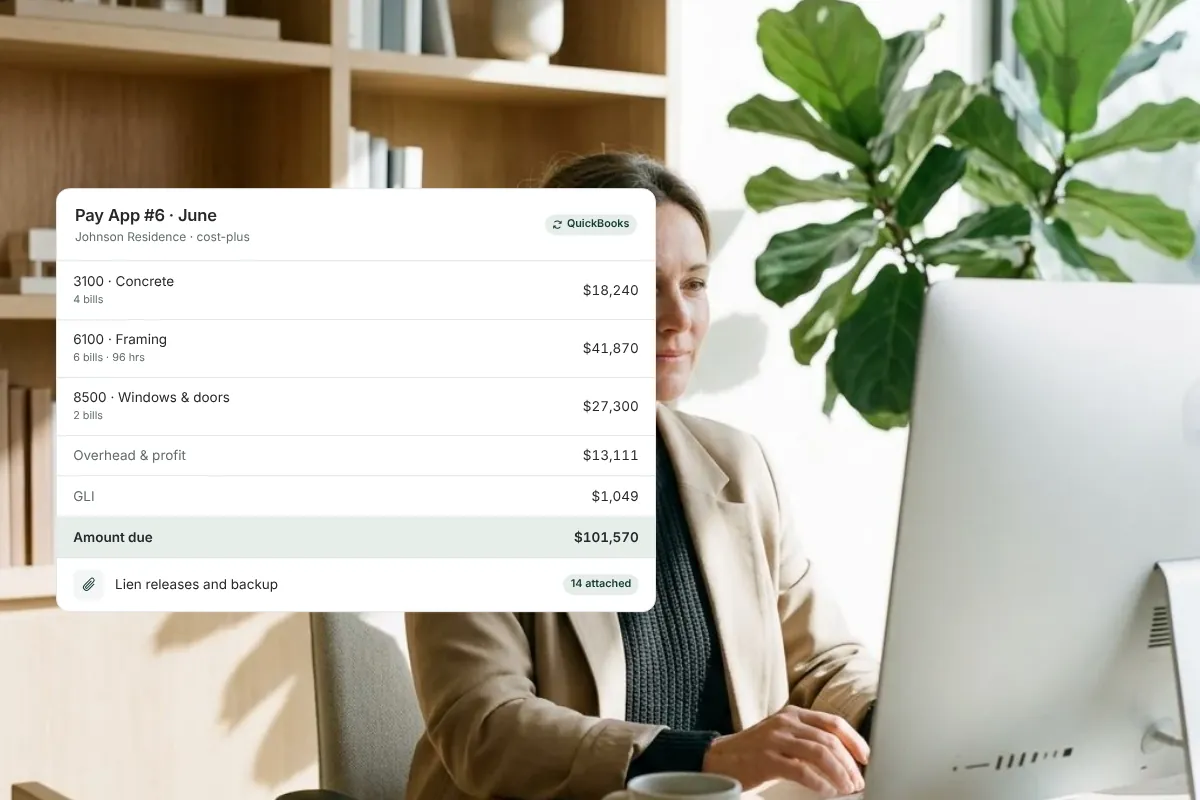
How to Create a Pay Application for a Custom Home (Step by Step)
A step-by-step guide to building a custom home pay application: backup by cost code, schedule of values, retainage and G702/G703 formats explained.
Get started with Ally
Start with one project and expand as your business grows. No hidden fees, no long-term contracts.