
Retainage in Residential Construction: How It Works and How to Track It

Summary
Retainage is a portion of each progress payment, commonly 5–10%, that the owner holds back until the work is substantially complete. On a custom home you may be tracking it twice: what the owner holds from you and what you hold from subs. This guide explains how it works, how it often differs on cost-plus and fixed-price work, and how to track it without hurting cash flow.
On this page
- Key takeaways
- How does retainage work, step by step?
- A worked example
- What is a typical retainage percentage in home building?
- How retainage commonly differs on cost-plus vs. fixed-price work
- When is retainage released?
- How to track retainage on a custom home
- How Ally keeps the records retainage depends on
- Frequently asked questions
Retainage (also called retention) is a percentage of each progress payment that the owner holds back until the work is substantially or fully complete, as an incentive to finish and fix punch items. On residential projects it’s commonly 5–10% when it’s used at all. The contractor tracks retainage held by the owner and, often, retainage it holds from subcontractors, and bills the release at closeout.
This is general information, not legal advice; check your contract and state law. Many states limit retainage rates or set deadlines for releasing it.
Key takeaways
- Retainage is money you’ve earned but won’t receive until a defined milestone, usually substantial completion.
- Rates of 5–10% are common, but the contract and state law control the rate and the release terms.
- On cost-plus custom homes, retainage is often lower, applied only to certain costs, or not used at all; on fixed-price work it’s more common.
- Track retainage in two directions: what the owner holds from you and what you hold from subs.
- Retainage can strain a small GC’s cash flow, so mirror your sub terms to your owner terms where you can.
How does retainage work, step by step?
- The contract sets the terms: the rate (for example 10%), what it applies to, when it’s released, and sometimes a reduction after a milestone such as 50% complete.
- Each pay application withholds it: the owner pays the amount earned this period minus retainage.
- Retainage accumulates: the total held grows with every draw.
- Release is billed at the milestone: usually substantial completion or final completion, often conditioned on punch list completion, final lien releases and closeout documents.
- Subcontractor retainage follows its own terms: if you hold retainage from subs, you release theirs according to their subcontracts, often after their scope is complete and accepted.
A worked example
Consider a fixed-price remodel with a contract sum of $600,000 and 10% retainage, billed monthly. Example figures only.
| Draw | Work completed this period | Retainage held (10%) | Paid to contractor | Total retainage held to date |
|---|---|---|---|---|
| 1 | $90,000 | $9,000 | $81,000 | $9,000 |
| 2 | $150,000 | $15,000 | $135,000 | $24,000 |
| 3 | $180,000 | $18,000 | $162,000 | $42,000 |
| 4 | $150,000 | $15,000 | $135,000 | $57,000 |
| 5 | $30,000 | $3,000 | $27,000 | $60,000 |
| Release | — | −$60,000 | $60,000 | $0 |
By the last draw, $60,000 of earned money is sitting with the owner. If the contract allowed retainage to drop to 5% once the job passed 50% complete (during draw 3), draws 4 and 5 would have withheld $9,000 less, which matters to a small builder’s cash flow.
Now say your framing sub’s $120,000 subcontract also carries 10% retainage. You’ve held $12,000 from them by the time framing is done. If their subcontract releases retainage when their scope is accepted, but your owner contract releases yours only at substantial completion, you could be paying out $12,000 months before you receive the matching amount. That timing gap is one of the main cash-flow risks retainage creates.
What is a typical retainage percentage in home building?
On residential projects that use retainage, 5–10% is common, with 10% more typical on larger fixed-price contracts and 5% or less common on smaller jobs. Some contracts reduce the rate after a milestone, cap the total held, or release it in stages. Many custom home contracts don’t use retainage at all, relying instead on the owner’s ability to withhold for documented defects or on lender draw controls.
Several states regulate retainage on private projects, including maximum rates and deadlines for release after completion. Check the rules where you build before you set terms.
How retainage commonly differs on cost-plus vs. fixed-price work
| Fixed-price | Cost-plus | |
|---|---|---|
| How common | Common, especially with lenders or architects involved | Less common; often reduced or omitted |
| What it applies to | Usually the full amount earned each period | Sometimes only the fee, or only subcontracted work |
| Why the owner wants it | Leverage to finish and correct work under a fixed price | Less needed: the owner already sees and reimburses actual costs |
| Contractor risk | Earned money held for months | Paying subs and suppliers before reimbursement if retainage applies to costs |
On cost-plus work the owner is reimbursing documented costs, so holding back a share of those costs can leave the contractor financing the job. When retainage is used on cost-plus custom homes, applying it to the fee only, or to subcontracted work that carries its own retainage, is a common compromise. Our comparison of cost-plus vs. fixed-price contracts goes deeper on how each changes budget management.
When is retainage released?
Most contracts release retainage at substantial completion (the home is usable for its intended purpose, with only minor punch items left) or at final completion. Common conditions include:
- Punch list items completed and accepted (see running a custom home punch list).
- Final lien releases from the contractor and from subs and suppliers.
- Closeout documents: warranties, manuals, as-builts, final inspection or certificate of occupancy.
- A final pay application that bills the retainage release as its own line.
Some owners hold back a specific amount for open punch items rather than the full retainage. Agreeing on that mechanism in the contract avoids arguments at the end of the job, when everyone is tired and the relationship matters most.
How to track retainage on a custom home
Retainage is easy to lose track of because it accumulates quietly across many draws and many subcontracts. Track it in both directions:
- Receivable retainage: what the owner holds from you, by draw and in total, with the release conditions.
- Payable retainage: what you hold from each sub, by subcontract and in total, with each sub’s release terms.
- The gap: any sub retainage you’ll owe before your own is released. Plan cash for it.
- Release readiness: which conditions (punch, releases, documents) are still open.
Showing retainage clearly on every pay application, held this period and held to date, also keeps the owner informed. It’s their money in the sense that they’re holding it, and they should be able to see the balance without asking.
How Ally keeps the records retainage depends on
Retainage disputes are rarely about the percentage. They’re about whether the release conditions have been met and whether everyone agrees on what was paid. Ally’s pay applications are built for cost-plus billing: each one pulls the period’s vendor bills and timesheet entries by cost code, applies the contract’s markup and GLI, and shows changes to deposits held, so the owner can see exactly what was billed, paid and held on every draw. Invoices sync to QuickBooks Online.
The records that release conditions depend on live with the project too: vendor lien releases signed online and attached to the next pay app, the punch list by room, and the documents you share with the owner. When it’s time to bill a release, the evidence is already in one place. See how Ally’s pay application software keeps billing transparent, and read how to create a pay application for a custom home for the full process.
Frequently asked questions
What is retainage in construction?
Retainage is a percentage of each progress payment that the owner holds back until the work reaches a defined milestone, usually substantial completion. It gives the owner leverage to see the job finished and punch items corrected. The contractor bills the accumulated retainage for release at the end, subject to the contract’s conditions.
Is retainage common on residential projects?
It depends on the contract. Retainage is common on larger fixed-price residential projects, especially with a lender or architect involved. Many cost-plus custom home contracts use a lower rate, apply it only to the fee or to subcontracted work, or don’t use it at all. Check your contract and state law.
Can a contractor hold retainage from subcontractors?
Yes, if the subcontract allows it, and many do, often at the same rate the owner holds from the contractor. Watch the release terms: if subs are owed their retainage before the owner releases yours, you may need to fund the gap. This is general information, not legal advice.
How do you bill retainage at the end of a project?
Once the release conditions are met, the contractor submits a final pay application that bills the accumulated retainage as a line, usually with final lien releases and closeout documents attached. Some contracts release retainage in stages or hold back a specific amount for open punch items.
Does retainage apply to change orders?
Usually, yes. Most contracts apply retainage to all work billed, including approved change orders, unless they say otherwise. Budget revisions and allowance adjustments on cost-plus work follow whatever retainage terms the contract sets for costs.
Want retainage, backup and approvals in one place? Book a demo.
Related resources
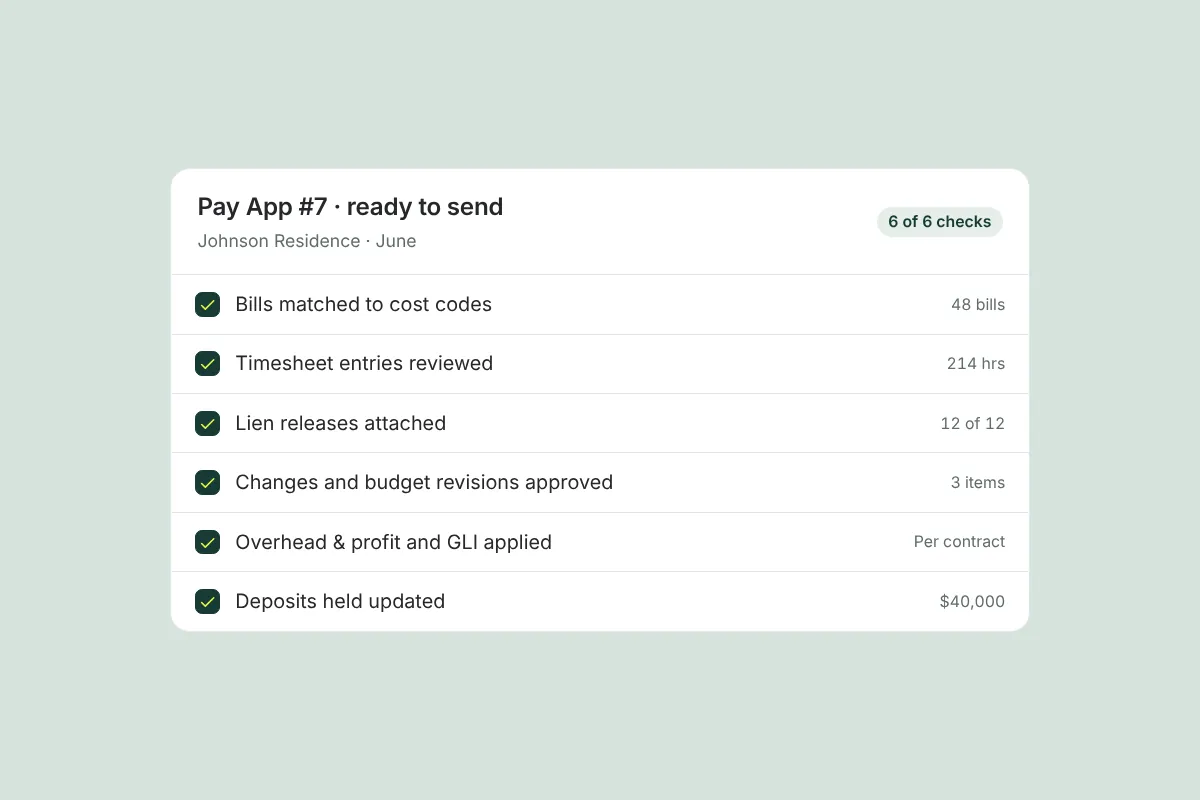
How to Prepare Accurate, Fully Documented Pay Applications
A pre-submission checklist for custom home pay applications: matched invoices, lien releases, approved changes, honest percent complete and clean math.

How to Create a Pay Application for a Custom Home (Step by Step)
A step-by-step guide to building a custom home pay application: backup by cost code, schedule of values, retainage and G702/G703 formats explained.

How to Collect and Track Lien Releases from Subs and Suppliers
Learn how to collect and track lien releases from subs and suppliers on every job, so you never close out a project with an unresolved lien hanging over it.
Get started with Ally
Start with one project and expand as your business grows. No hidden fees, no long-term contracts.