
Cost-Plus vs. Fixed-Price Contracts: How Each Changes the Way You Manage a Budget
Summary
Fixed-price contracts put cost risk on the contractor and keep costs private; cost-plus contracts share actual costs with the owner and put transparency at the center. Each needs a different budget discipline: protecting margin and managing scope on fixed-price, and showing documented costs, budget revisions and projected final cost on cost-plus.
On this page
- Key takeaways
- Cost-plus vs. fixed-price at a glance
- How fixed-price contracts work in residential construction
- How cost-plus contracts work in residential construction
- Pros and cons for residential builders
- Which contract type is best for a custom home?
- What should a cost-plus budget report show the owner?
- How Ally supports both, built for cost-plus transparency
- Frequently asked questions
In a fixed-price contract, the contractor agrees to build the defined scope for a set price and carries the risk of costs running over. In a cost-plus contract, the owner pays the actual cost of the work plus a fee, and sees the costs. Fixed-price budgets are managed to protect margin and control scope; cost-plus budgets are managed for transparency, with documented costs, budget revisions and a projected final cost the owner can follow.
Key takeaways
- Fixed-price shifts cost risk to the contractor; cost-plus shares it with the owner in exchange for full visibility.
- Many high-end custom homes are built cost-plus because the design keeps evolving during construction.
- Cost-plus budgets live or die on documentation: invoices, timesheets, budget revisions and approvals the owner can trace.
- On cost-plus work, not every cost adjustment is a change order; budget revisions and allowance adjustments do much of the work.
- Whichever contract you use, track projected final cost, not just spending.
This is general information, not legal advice; check your contract and state law.
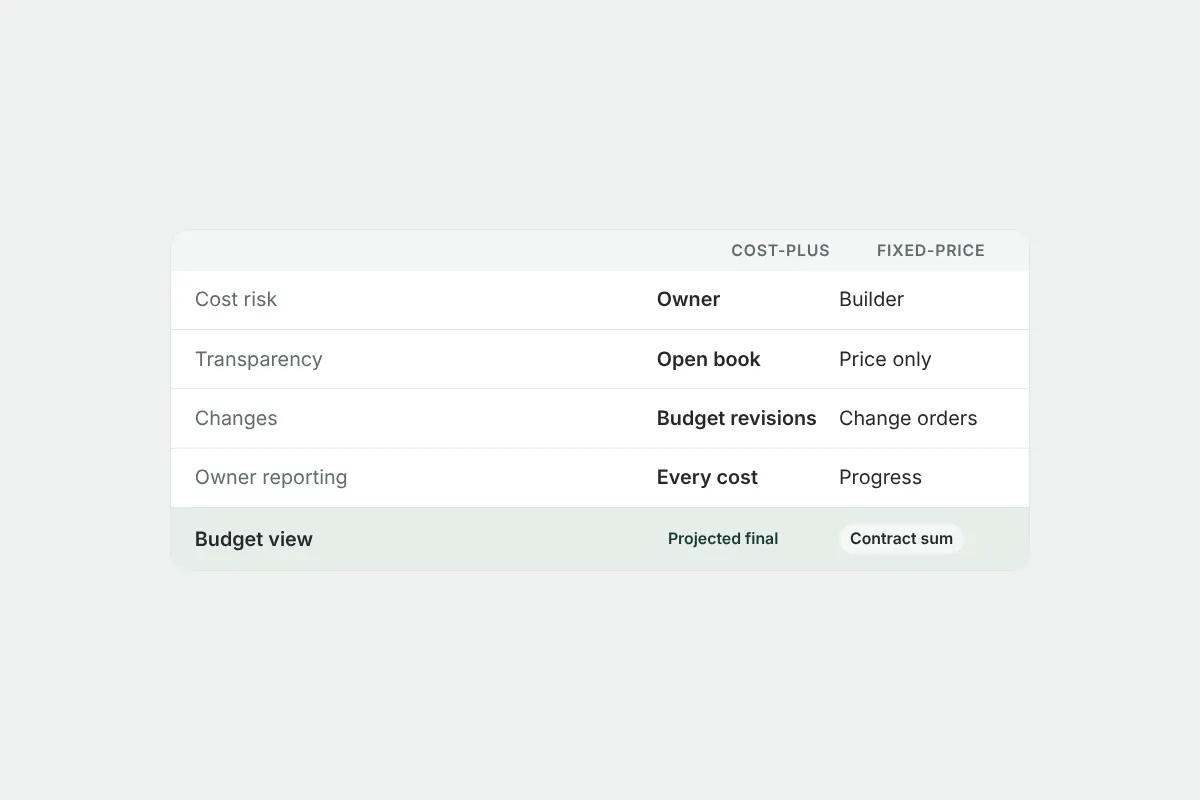
Cost-plus vs. fixed-price at a glance
| Fixed-price (lump sum) | Cost-plus (open book) | |
|---|---|---|
| Price | Set at signing for the defined scope | Actual cost of the work plus a fee (percentage or fixed) |
| Who carries cost risk | Mainly the contractor | Mainly the owner, within the contract’s terms |
| Transparency | Owner sees the price, not the costs | Owner sees costs, invoices and the fee |
| Best fit | Fully designed projects with stable scope | Custom homes where design and selections evolve |
| How scope changes are handled | Formal change orders, priced with markup | Budget revisions, allowance adjustments and change orders, each documented appropriately |
| Admin workload | Heavier estimating up front; lighter cost reporting | Lighter up-front pricing; heavier ongoing documentation |
| Client trust | Depends on the change order process | Depends on the clarity of cost reporting |
| Where disputes start | Whether a change is “in scope” | Whether costs are justified and the budget was communicated |
How fixed-price contracts work in residential construction
With a fixed price, the contractor estimates the full scope, adds overhead and profit, and commits to a number. If the framing package comes in high, that is the contractor’s problem; if buyout comes in low, the savings are the contractor’s margin.
Fixed-price works well when the design is complete and stable: a production or semi-custom home, or a remodel with fully specified finishes. It works poorly when the owner is still designing during construction, because every change becomes a negotiation over whether it was in the original scope.
Budget-tracking practices for fixed-price work
- Track cost against your internal estimate by cost code to protect margin, even though the owner doesn’t see it.
- Watch committed costs closely during buyout; that is where margin is won or lost.
- Define scope precisely, including allowances and exclusions, so changes are clearly identifiable.
- Use formal change orders for owner-requested changes, priced with direct cost, markup and schedule impact. See how to write a construction change order.
How cost-plus contracts work in residential construction
With cost-plus, the owner pays the actual costs of the work (labor, materials, subcontracts and the general conditions the contract allows) plus the contractor’s fee. The fee may be a percentage of cost or a fixed amount, and some contracts add a guaranteed maximum price. Because the owner is paying actual costs, they are entitled to see them, and on a high-end custom home they usually want to.
Cost-plus is common for high-end custom homes because it fits the way those projects actually happen: architects and designers keep refining details, owners make hundreds of selections during construction, and unforeseen conditions surface. Rather than pricing every unknown up front with contingency, cost-plus lets the budget evolve openly.
Budget-tracking practices for cost-plus work
- Lead with transparency. The owner should be able to see the original budget, current revised budget, costs to date and projected final cost without asking for a report. See how to track a custom home budget.
- Document every cost. Invoices, timesheets, labor charges and lien releases should tie to cost codes and be available as backup with each pay application.
- Use the right adjustment for the situation. On cost-plus work, many budget movements are budget revisions or allowance adjustments, not change orders. Our guide to change orders vs. budget revisions walks through the five types.
- Get approval before major commitments. Show the owner significant subcontracts and purchases, with how they compare with the budget, before you commit.
- Watch general conditions. On cost-plus, schedule extensions often show up as additional general conditions cost; communicate them as they happen.
Pros and cons for residential builders
Fixed-price
- Pros: potential for higher margin with good buyout; owner has price certainty; less ongoing cost reporting.
- Cons: contractor carries overrun risk; contingency inflates the price; scope arguments over every change.
Cost-plus
- Pros: flexibility for evolving designs; lower risk for the contractor; trust built through openness.
- Cons: heavier documentation; owner may question costs if reporting is unclear; final price uncertain until the end unless capped.
Which contract type is best for a custom home?
There is no single answer. Fixed-price suits projects that are fully designed with stable scope. Cost-plus suits custom homes where design, selections and site conditions will keep evolving, as long as the contractor can provide the transparency it requires. Some builders use hybrids: cost-plus with a guaranteed maximum price, or a fixed fee with open-book costs. Whatever the structure, the owner’s trust depends on understanding the project’s financial position at any point.
What should a cost-plus budget report show the owner?
On cost-plus work, the budget report is the main way the owner experiences transparency. A good one answers their questions before they ask:
- Where are we? Original budget, current revised budget, costs to date and the fee to date.
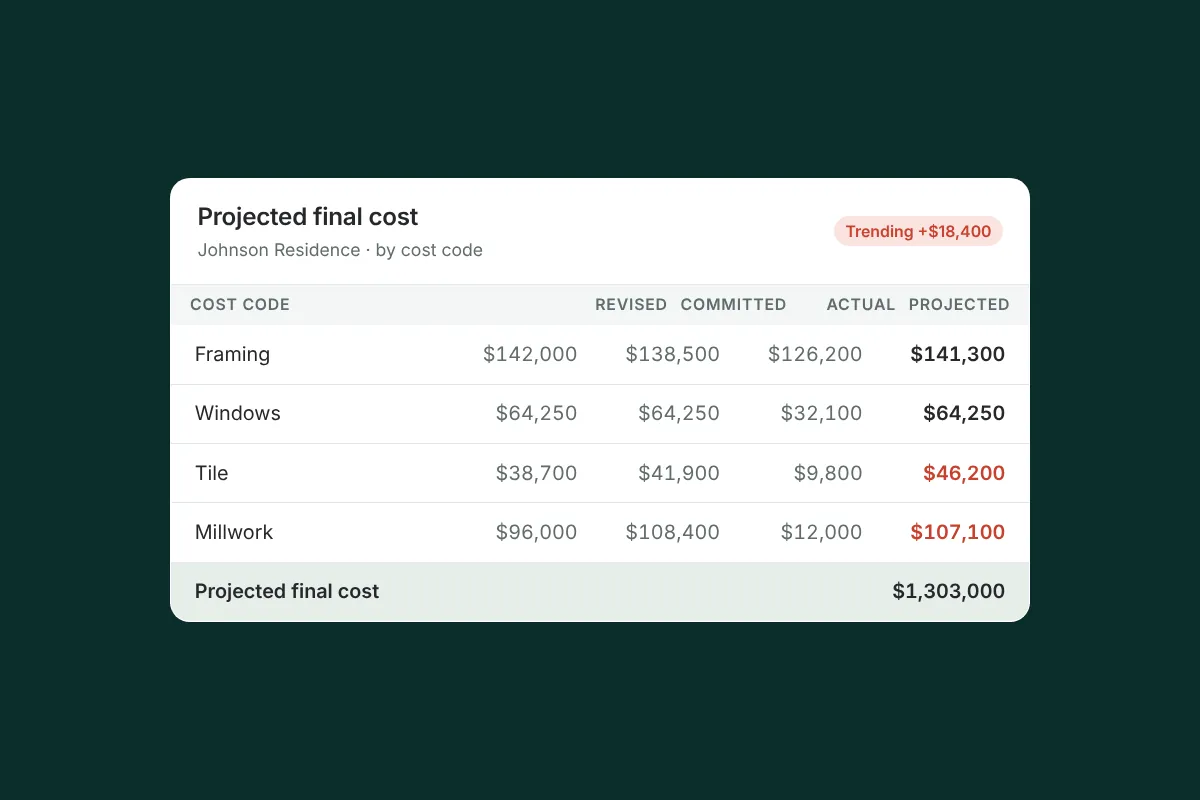
- Where are we heading? Committed costs, anticipated cost to complete and projected final cost by cost code.
- What changed and why? Each budget revision, change order and allowance adjustment since the last report, with the date and who approved it.
- What do I need to decide? Open selections and pending approvals, with their decision dates and potential cost impact.
- What am I paying for? The current pay application, with invoices, timesheets and lien releases as backup.
When the owner can trace any number back to a document, the conversation shifts from “why is this so high?” to “what do we want to do about it?”
How Ally supports both, built for cost-plus transparency
Ally ties the budget to the approvals, change orders and bids already in the system. Approved change orders update the budget automatically, awarded bids flow straight into it, and owners can see where their money is going. Pay applications draw from approved changes and bills, with lien releases, receipts, invoices and timesheets attached, so the owner sees exactly what they are paying for. That documentation-first approach is what cost-plus work demands. Learn more about budget management in Ally.
Frequently asked questions
What is the difference between cost-plus and fixed-price contracts?
A fixed-price contract sets one price for a defined scope, and the contractor carries the risk of overruns. A cost-plus contract has the owner pay actual costs plus a fee, with the costs visible to the owner. Fixed-price favors price certainty; cost-plus favors flexibility and transparency.
What are the pros and cons of a cost-plus contract for residential construction?
Pros: flexibility as the design evolves, less contingency built into pricing, and trust through open books. Cons: more documentation, a final price that isn’t certain until completion unless capped, and owner questions about costs if reporting is unclear.
How do you manage a cost-plus budget?
Share the original budget, revised budget, costs to date and projected final cost with the owner. Tie every invoice and timesheet to a cost code, document budget revisions and change orders with approvals, and review major commitments with the owner before signing them.
What is open-book pricing for a home builder?
Open-book pricing means the owner can see the builder’s actual costs, such as invoices, subcontracts and labor, along with the fee. It is the core of cost-plus contracting and depends on organized, accessible documentation.
Which contract type is best for custom homes?
Fixed-price fits fully designed projects with stable scope. Cost-plus fits custom homes where design and selections evolve during construction, provided the builder offers clear cost reporting. Hybrids like cost-plus with a guaranteed maximum price are also common.
Running cost-plus projects? Book a demo to see how Ally keeps owners informed.
Related resources
How to Track a Custom Home Budget: Current Financial Position and Projected Final Cost
Actual costs alone can hide an overrun. Track six numbers by cost code, through projected final cost, to see where a custom home budget is really heading.

Allowances in Construction Contracts: How to Manage Them Without Surprising Your Client
What a construction allowance is, why allowances cause budget fights, how to set realistic amounts and how to show homeowners running allowance balances.
Spreadsheet vs. Project Management Software for Small Residential Builders: When to Switch
An honest comparison of spreadsheets vs. construction project management software for small residential builders, and the signs it’s time to switch.
Get started with Ally
Start with one project and expand as your business grows. No hidden fees, no long-term contracts.