
How to Price Changes on a Custom Home: Cost-Plus vs. Fixed-Price
Summary
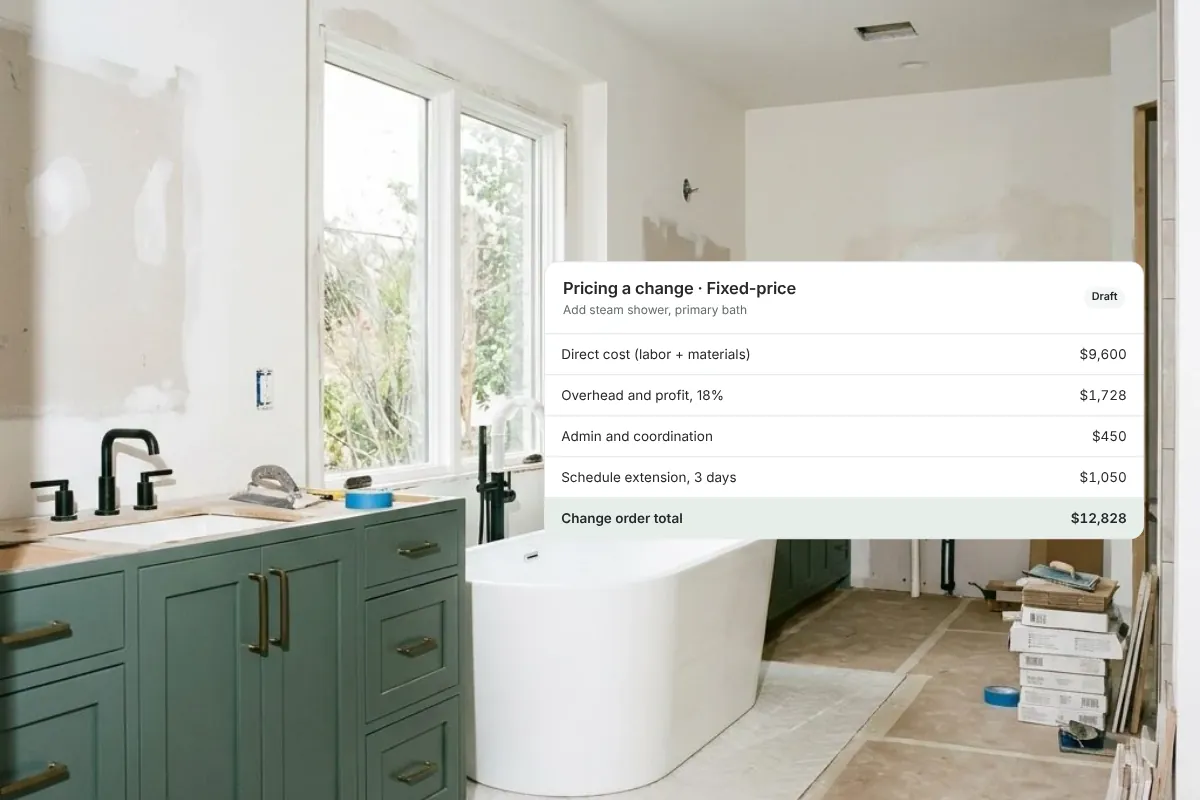
A fairly priced change covers more than materials and labor. On fixed-price work, include direct cost, overhead and profit, the time to price and manage the change, and any schedule extension. On cost-plus work, apply the contract’s fee as written and reflect added general conditions in the revised budget.
On this page
- Why do builders undercharge for changes?
- How to price a change on a fixed-price contract
- Worked example: fixed-price change
- How to price a change on a cost-plus contract
- How should schedule impact be shown?
- What markup percentage is typical for residential change orders?
- How Ally helps you price and document changes
- Frequently asked questions
To price a change on a custom home, start with the direct cost of labor, materials, equipment and subcontracts. On a fixed-price contract, add overhead and profit, the time it takes to price and manage the change, and the cost of any schedule extension. On cost-plus work, apply the fee your contract specifies and update the revised budget for added general conditions.
- Most residential builders undercharge for changes by pricing only the materials and labor.
- On fixed-price work, a change price should cover direct cost, overhead, profit, admin time and schedule impact.
- On cost-plus work, the fee usually applies to changes automatically; the bigger risk is forgetting added general conditions.
- Show the owner the schedule impact with the price, so they decide with the full picture.
- Markup percentages vary by builder and market; your contract’s change pricing terms are the rule that matters.
Why do builders undercharge for changes?
Pricing a change usually happens fast: on a walkthrough, in a text thread, or late in the day between other calls. Under that pressure it’s natural to add up the visible cost of the work and stop there.
The costs that get missed are the ones that don’t show up on a supplier invoice:
- The project manager’s time to scope, price, document and get the change approved.
- Re-coordination: revised drawings, updated orders, rescheduled trades.
- Extra weeks of supervision, site costs and equipment if the change pushes the finish date.
- Risk on work that’s harder to estimate once the house is partly built.
None of this is padding. It’s real cost, and on a $3 million custom home a handful of underpriced changes can quietly erase a meaningful share of the margin. Pricing changes properly also protects the owner relationship, because a change priced honestly up front is easier to accept than a surprise in the final accounting.
How to price a change on a fixed-price contract
On fixed-price work, the change order adjusts the contract sum, so the price you quote is the price. Build it from five parts.
1. Direct cost
Labor (your crew’s hours at their loaded rate), materials, equipment rental and any subcontractor pricing. Get sub quotes in writing before you quote the owner, and note what’s excluded.
2. Overhead
The share of your company’s fixed costs that the change consumes: office, insurance, vehicles, software, supervision. Many residential builders apply overhead as a percentage of direct cost, based on their actual annual overhead.
3. Profit
Changes carry the same business risk as base-contract work, often more. Profit on changes is commonly in the same range as the original contract’s margin. Some contracts set the combined overhead-and-profit percentage for changes; if yours does, use it.
4. Admin and management time
Pricing, documenting, presenting and tracking a change takes real hours. Some builders include this in overhead; others list it as a line item on larger changes. Either way, account for it. Whether you can show it separately depends on your contract.
5. Schedule extension cost
If the change adds time to the critical path, your general conditions continue for those extra days: supervision, site facilities, equipment, insurance and temporary utilities. Price the extension and state the added days on the change order.
Worked example: fixed-price change
An owner asks to extend a covered back porch by 8 feet. This example uses round numbers; your rates will differ.
| Line | Basis | Amount |
|---|---|---|
| Framing labor | Crew, 48 hours at $75/hour loaded | $3,600 |
| Materials | Lumber, hardware, decking, fasteners | $6,200 |
| Roofing subcontractor | Written quote | $4,800 |
| Electrical subcontractor | Two added fixtures, one fan, written quote | $1,400 |
| Direct cost | $16,000 | |
| Overhead | 12% of direct cost (example rate) | $1,920 |
| Profit | 10% of direct cost plus overhead (example rate) | $1,792 |
| Admin and coordination | Revised drawings, re-ordering, sub coordination: 6 hours at $95/hour | $570 |
| Schedule extension | 4 added working days of general conditions at $450/day | $1,800 |
| Change order price | $22,082 |
Quoting only the materials and labor would have been $9,800. Quoting direct cost alone would have been $16,000. The fully priced change is $22,082, plus four working days added to the schedule, both shown on the change order before the owner signs.
How to price a change on a cost-plus contract
On cost-plus work, you don’t set a fixed price for the change. The owner pays the actual cost of the added work plus the fee your contract defines. Pricing a change here is mostly about estimating accurately and applying the contract consistently.
Apply the fee the way the contract says
Most cost-plus contracts apply the same fee percentage to changes as to the base work, but some use a different rate for changes, cap the fee, or use a fixed fee that only adjusts above a threshold. Read the clause and apply it exactly. If the contract is silent, raise it with the owner before the first change, not during the fifth.
Include added general conditions in the revised budget
The cost builders most often miss on cost-plus changes is general conditions. If the porch extension adds four days, your supervision, site costs and equipment run four days longer. Those are reimbursable costs under most cost-plus agreements, but only if the budget shows them. Put them in the revised budget at the time of the change so the owner sees the full effect, not at closeout.
Estimate first, then track actuals
Give the owner an estimate when they authorize the change, so they know what they’re approving. Then track the actual cost against that estimate on the cost code, so the projected final cost stays honest. If actuals run over, revise the budget and explain why. Our guide to tracking projected final cost walks through the method.
Cost-plus example
| Porch extension on a cost-plus contract (example) | Amount |
|---|---|
| Estimated direct cost (labor, materials, subs) | $16,000 |
| Added general conditions, 4 days | $1,800 |
| Estimated cost of the work | $17,800 |
| Contractor’s fee at 15% (per contract, example rate) | $2,670 |
| Estimated change to the projected final cost | $20,470 |
Because this is an owner-requested scope change, it still goes through a formal change order, even on cost-plus. Many other cost-plus adjustments don’t. Our article on change orders vs. budget revisions explains which is which.
How should schedule impact be shown?
Every change order should state its schedule effect, even when it’s zero. A line like “Adds 4 working days; revised substantial completion March 14” prevents the most common follow-on dispute: an owner who approved the cost but not the delay. If the change affects other trades, note which ones, so the schedule update reaches everyone who needs it.
What markup percentage is typical for residential change orders?
There’s no single standard. Combined overhead and profit on residential changes commonly lands somewhere between the mid-teens and the mid-twenties as a percentage, depending on the builder’s size, market and contract. Some contracts set it explicitly. The right number is the one that recovers your real overhead and earns a fair margin, applied consistently and disclosed in the contract. This is general information, not legal advice; check your contract and state law.
How Ally helps you price and document changes
In Ally, every change order goes to the owner with its scope, cost and schedule impact, and comes back with a timestamped approval. Approved changes flow into the budget and the schedule, so the projected final cost and the finish date stay in sync without re-entry. Because budget revisions are tracked separately, added general conditions or a bid variance can be recorded with its reason, and the owner sees one current number. Learn more about change order management in Ally.
Frequently asked questions
How do you price a change order?
Add up the direct cost (labor, materials, equipment and subcontractor quotes), then add overhead, profit, the time to price and manage the change, and any schedule extension cost. On cost-plus contracts, estimate the cost of the work including added general conditions, then apply the contract’s fee. State the schedule impact with the price.
Should contractors charge for change order admin time?
Yes, the time is a real cost. Whether it appears as its own line or inside overhead depends on your contract and how you present pricing. On small changes it’s usually covered by overhead; on larger changes that need revised drawings and re-coordination, many builders show it separately so the owner understands the effort involved.
Does the cost-plus fee apply to change orders?
In most cost-plus contracts, yes: the fee applies to the cost of changed work the same way it applies to the base work. Some contracts use a different rate, a cap, or a fixed fee with adjustments above a threshold. Follow the contract’s wording, and clarify it with the owner before the first change if it’s unclear.
How do I account for schedule impact in a change order?
State the number of working days the change adds and the revised completion date, even if the answer is zero. On fixed-price work, include the cost of extended general conditions in the price. On cost-plus work, add those costs to the revised budget so the projected final cost reflects them.
What is a typical change order markup for residential construction?
It varies by builder and market. Combined overhead and profit commonly falls between the mid-teens and mid-twenties as a percentage of direct cost. The defensible approach is a rate grounded in your actual overhead and margin, written into the contract and applied the same way on every change.
See how Ally ties change pricing to the budget and schedule: book a demo.
Related resources
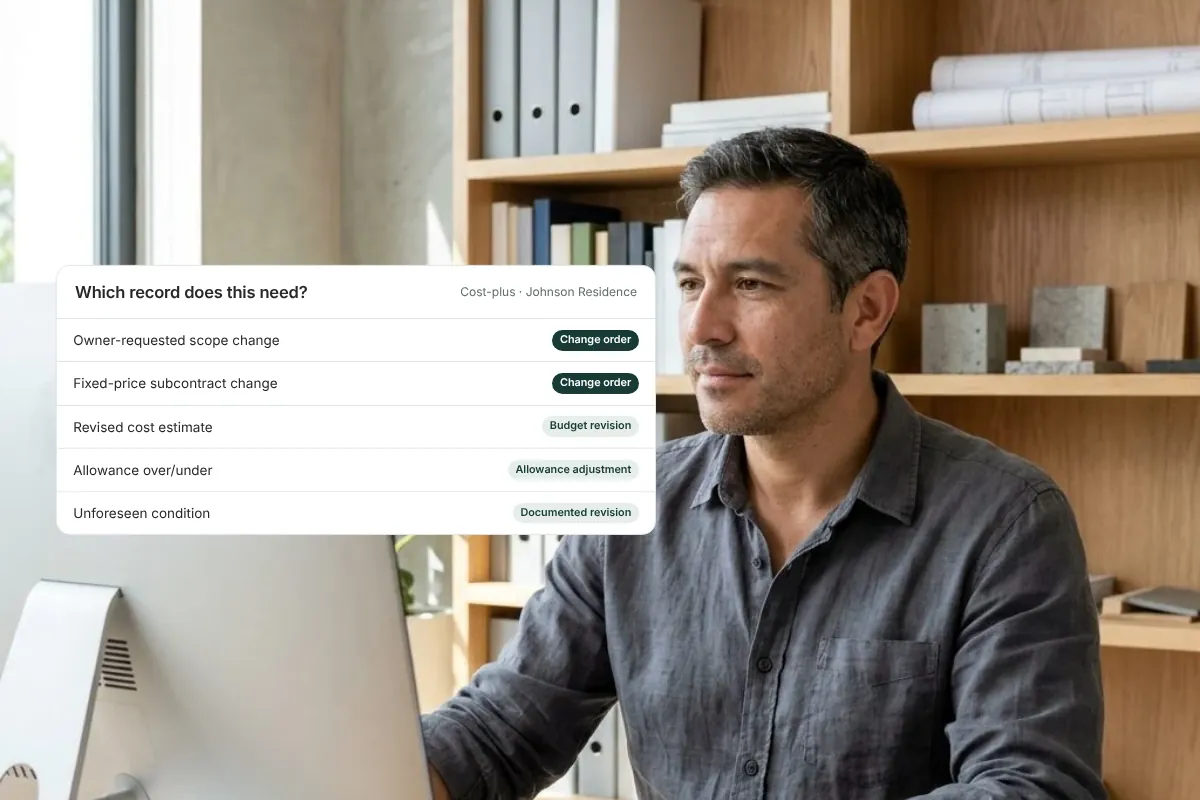
Change Orders vs. Budget Revisions: What Custom Home Builders Need to Know
Not every cost adjustment is a change order. Learn the five types of cost change on a custom home and the right way to document and authorize each one.
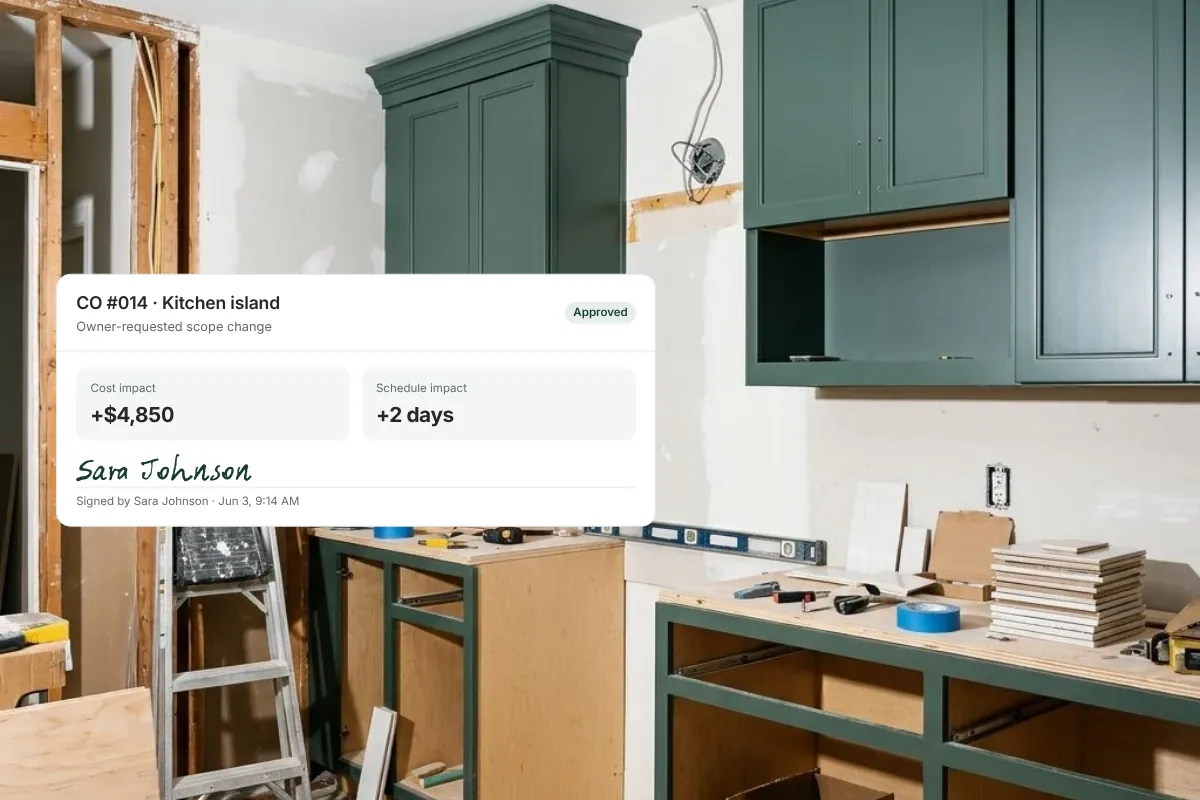
How to Write a Construction Change Order
How to write a construction change order: what to include (scope, cost, schedule impact, approval), a copy-ready template and a worked example.

What to Do When a Homeowner Keeps Changing Their Mind Mid-Build
When a homeowner keeps changing their mind mid-build, costs spiral and timelines collapse. Here's how to protect your project and your sanity.
Get started with Ally
Start with one project and expand as your business grows. No hidden fees, no long-term contracts.